Compare the best fintech software development services in 2026: CloudGeometry, Praxent, EPAM, DataArt and more, by layer, sign-off model and brownfield fit.
Key Takeaways (TL;DR)
- Best Overall for Existing FinTech Systems: CloudGeometry runs fintech software development as an AI-managed software lifecycle. The work happens in your repositories and your cloud account, every change is specified and approved before it is built, and a named CloudGeometry engineer signs off before anything ships. That answers the question most fintech buyers are asking in 2026: can we keep our current codebase, cloud and security setup and still move faster with AI?
- This List Is Not One Category: the nine companies below operate at three different layers. Some are delivery organizations that supply teams. Some sell a banking platform with a team around it. One runs the whole change lifecycle as a managed service. Decide which layer you are buying before you compare names.
- What FinTech Changes About the Choice: every change touches money, and someone outside engineering will ask what changed, who approved it and what was tested. A partner that produces that record as part of the work is worth more than one that reconstructs it afterwards.
- Price What You Can Compare: most firms on this list quote on request. Where a company publishes engagement ranges, they are quoted here with the source and the date checked. Nothing else is inferred.
- How to Choose: ask six questions. Which layer of the stack does the partner operate at; is execution supervised or autonomous; does it work on brownfield production systems; can you trace a deployed change back to its requirement; does system knowledge persist between sessions and people; and what unit are you buying.
- Who This Page Is Not For: teams building a brand-new product with no production system yet, and teams that want a seat license for a coding assistant. Several firms below serve the first group well; AI-MSL is built for software that already runs.
Table of Contents
- Top FinTech Software Development Services in 2026 at a Glance
- What FinTech Buyers Are Choosing Between in 2026
- Best FinTech Software Development Services: In-Depth Review and Comparison
- Why Does CloudGeometry Work Across FinTech Use Cases?
- When Does It Make Sense to Change Your Delivery Model?
- What Makes a Good FinTech Software Development Partner?
- How to Choose the Right FinTech Software Development Service for Your Needs
- Everything You Need to Know About FinTech Software Development Services
- Already Have a Development Partner? Add the Layer It Cannot Reach
- FAQs About FinTech Software Development Services
Top FinTech Software Development Services in 2026 at a Glance
Before comparing names, it helps to know that these nine companies do not all sell the same thing. The table sorts them by the layer they operate at, because that decides whether they are comparable at all. "Who signs off" records how each company describes its own release control. How each company positions itself toward systems that already run in production is covered in its entry below.
← scroll to see all columns →
| Company | Layer | Best For | Who Signs Off | Pricing |
|---|---|---|---|---|
| 01CloudGeometryBest overall | AI-managed software lifecycle: integrated platform and managed service | Fintech companies with production software that must keep changing under scrutiny | AI executes each stage; a named CloudGeometry engineer approves every gate | Plans published; pilot on one backlog item |
| 02Praxent | AI transformation firm for financial services | Banks, lenders and payment companies adopting agentic engineering and back-office agents | Human approval of "each decision that matters" (company wording) | Outcome-based fee tied to client KPIs (company wording); figures on request |
| 03EPAM Systems | Global delivery organization | Large financial institutions that want a listed partner with broad practices and procurement history | Client-run governance with EPAM teams embedded | Time-and-materials and statement-of-work; on request |
| 04DataArt | Delivery organization with a finance practice | Capital markets, asset management, payments and digital banking programs | Client-run governance | On request |
| 05Intellias | Delivery organization with a financial services and insurance practice | Banks and trading platforms that want engineering squads and applied AI | Client-run governance; "human-in-the-loop controls" for AI work (company wording) | On request |
| 06Itexus | Fintech-focused delivery organization | Mid-sized fintechs that want a US-headquartered team with European delivery | Client-run governance; Agile delivery | Published ranges for discovery and enterprise projects |
| 07Django Stars | Delivery organization, Python-centered | Fintech products built on Python and Django | Client-run governance | On request |
| 08DashDevs | Fintech-only delivery organization with a configurable core | Digital banking, payments and lending launches that want a pre-built core | Client-run governance | On request |
| 09Velmie | Digital banking platform plus dedicated product team | Banks and fintechs launching accounts, cards and payment programs on a platform | Velmie's "release governance" inside its team model (company wording) | On request |
Every third-party fact on this page comes from the company's own public website, checked on 5 November 2026. Where a company does not state something, the table says "on request" or leaves it out.
What FinTech Buyers Are Choosing Between in 2026
A search for "fintech software development services" returns three different kinds of company, and most comparison lists mix them together. Separating them first saves a lot of wasted calls.
Delivery Organizations
These firms supply engineers, squads or whole teams. You own the roadmap and the release process; they bring capacity and domain experience in payments, lending, trading or banking. EPAM, DataArt, Intellias, Itexus and Django Stars all describe themselves this way, with different sizes and specialisms. The commercial unit is usually a person-month, and governance is whatever your organization already runs.
Platform Vendors With a Team Around Them
Velmie and, to a degree, DashDevs sell a pre-built banking or fintech core and a team to configure and extend it. This is the fastest route to a new account, card or wallet product, and the trade-off is that the platform's architecture now sits in the middle of your system. For a greenfield launch that is often the right trade.
Managed Lifecycle Services
CloudGeometry's AI-MSL takes a different approach. Instead of supplying people or a platform, it runs the change lifecycle itself: a change is specified from business intent, its impact is analyzed against a continuously maintained model of your system, it is implemented and tested by AI, and a CloudGeometry engineer approves each gate before it moves on. The unit is a change, not a person. Praxent's agentic engineering work sits near this layer for financial services clients, with a different operating model.
Different approaches optimize for different outcomes. Capacity models are good when you know what to build and need more hands. Platform models are good when you are launching something standard. A managed lifecycle is good when the hard part is keeping an existing system changing without losing control of what changed.
Best FinTech Software Development Services: In-Depth Review and Comparison
1. CloudGeometry
Overview
CloudGeometry is a Sunnyvale, California engineering company that runs AI-MSL, an AI-managed software lifecycle, delivered as an integrated platform and managed service. The platform keeps a continuously maintained model of your system, called AppGraph, so every change is specified and implemented with knowledge of the code, dependencies and workflows it touches. The managed service puts an AI Lifecycle Manager on the engagement and AI-MSL Engineers on the approval gates.
This is the one entry on the list that does not sell people or a platform. The customer submits a change request. AI-MSL turns it into requirements, a specification and an impact analysis. Once the customer approves, AI executes implementation, testing and documentation, and a CloudGeometry engineer approves release readiness before anything merges. Every AI action in between is logged with timestamp, actor and reasoning.
For fintech, the relevant property is the record. Each change carries the request, the approved scope, the specification, the sign-offs by name and the test results, produced as part of the work rather than assembled afterwards. The fintech industry page describes how that applies to KYC flows, payment integrations and reporting pipelines. CloudGeometry is an Anthropic partner for Claude Code and an AWS consulting partner; the models and tools run inside the lifecycle rather than being the product.
Ideal For
- Fintech and financial software companies with production systems that are two or more years old and a backlog growing faster than the team can clear it
- Companies whose engineering runs through an outside vendor or remote team and who want one accountable party per change rather than more capacity
- CTOs and VPs of Engineering who need a change record that a risk function, a partner bank or an auditor can read without a reconstruction exercise
- Owners and operators who want to try the model on one real backlog item before committing to anything larger
Top Features
- One Governed Sequence: requirements, specifications, implementation, test and release run as a single lifecycle rather than a queue of hand-offs between teams.
- AppGraph System Knowledge: a maintained model of the code, dependencies, workflows and history of your system, so knowledge stays in the system and does not leave when an engineer does.
- Named Sign-Off at Every Gate: every action is logged with timestamp, actor and reasoning, and a CloudGeometry engineer approves before a change ships.
- Your Repositories, Your Cloud Account: work happens in your Git repositories and your cloud account, through your existing CI/CD, with no proprietary runtime to migrate onto.
- One Record for All Work: maintenance, modernization and new feature work run through the same lifecycle, so the change record is the same shape for all of it.
Why We Are the Right Fit for FinTech
We say "fit" rather than "best" on purpose. AI-MSL is built for one situation: software that already runs, that must keep changing, and where someone outside engineering will ask what changed and who approved it. If that is your situation, the lifecycle model gives you a change record and a sign-off chain without adding a process layer on top of a vendor team. If your situation is a new product launch, several companies on this list are a better match, and we say so in their entries.
Pros
- One accountable party for each change from intent to release
- System knowledge persists between changes and between people
- Low-commitment entry: the pilot runs one real backlog item in about a week
- No proprietary runtime to migrate onto; the code is yours, in your repositories
Cons
- Not offered for greenfield products with no existing system
- Not a seat license; teams that want a coding assistant for their own developers should look at tools, not at this page
- Not self-serve: engagements are scoped with a CloudGeometry engineer, and the onboarding assessment comes first
- A smaller company than the global firms on this list, which matters to buyers who need a vendor with a long procurement history
Pricing
Plans are published on the AI-MSL plans page. Each change is estimated and approved before it is built. The pilot includes $2,000 in Dev credits for the first backlog item.
Final Verdict
The strongest option on this list for a fintech company whose problem is an existing system under change pressure. Not the option for a launch.
2. Praxent
Overview
Praxent describes itself as an AI transformation firm for financial services, serving banking, lending, payments, capital markets, insurance and health benefits. Its services are grouped into AI-native people (agentic engineering and lifecycle enablement), AI-native processes (custom agents for back-office work, with "people approving each decision that matters") and AI-native products (customer experience products, legacy platform modernization under its PraxentDecode name, and data transformation).
The company states a team of 200 specialized experts and describes itself as a select Anthropic partner for financial services. Source: praxent.ai, checked 5 November 2026.
Ideal For
- Banks, lenders and processors that want a financial-services-only partner to introduce agentic engineering
- Operations leaders looking at back-office agents with human approval points
- Buyers who value an outcome-linked commercial model over time-and-materials
Top Features
- Financial Services Focus: banking, lending, payments, capital markets and insurance, with sector references on its site.
- Agent-Based Back-Office Automation: custom agents for financial operations with human approval points.
- Named Legacy Modernization Offering: platform modernization marketed under its own name.
- AI Controls Framework: a security and controls framework the company markets under its own name.
Why It Is a Strong Alternative
Praxent is the closest company on this list to CloudGeometry in intent: both put governed AI execution inside financial services engineering. The difference is the operating model. Praxent's offer is organized around transforming the client's own people and processes; AI-MSL runs the lifecycle as a managed service with CloudGeometry engineers on the gates. A buyer who wants to build the capability in-house will prefer the former; a buyer who wants the capability delivered will prefer the latter.
Pros
- Deep financial services vocabulary and sector references
- Commercial model the company says ties its fee to client results
- Covers both engineering and operations use cases
Cons
- Engagement figures are not published
- Transformation-led engagements depend on the client's own team adopting new practices
- Performance figures on its site are self-reported and should be validated in reference calls
Pricing
Outcome-based offerings described on its website; figures on request.
Final Verdict
A serious option for financial institutions that want to build AI-native engineering capability internally with a sector specialist.
3. EPAM Systems
Overview
EPAM Systems is a publicly listed global engineering and consulting firm with roughly 52,000 employees across more than 50 countries, per the company's own reporting. Its financial services practice is one of its largest verticals, covering banking, capital markets, payments, insurance and wealth management, alongside cloud, data, AI and digital product design practices. Source: epam.com, checked 5 November 2026.
Ideal For
- Large financial institutions that want a listed partner with established procurement pathways
- Fintech scale-ups planning multi-year programs that need deep bench strength
- Buyers who need every engineering discipline from one vendor
Top Features
- Scale: every engineering discipline a bank or payments company needs, in one firm.
- Established Financial Services Practice: regulatory domain experience across banking, capital markets and insurance.
- Global Delivery: distributed engineering with onshore client leadership.
- AI Investment: AI consulting and platform work across the practice.
Why It Is a Strong Alternative
If the program is large, long and needs a vendor that a procurement team already knows, EPAM is a safe choice. CloudGeometry takes a different approach: it is built for the mid-market fintech whose problem is a steady stream of changes to one system rather than a multi-year transformation. Our EPAM alternatives roundup goes into the trade-off in detail.
Pros
- Breadth and depth of engineering talent
- Financial services references at the largest institutions
- Procurement, security and contracting at enterprise standard
Cons
- Commercial model is headcount-based, so cost tracks team size rather than output
- System knowledge lives with the engagement team and leaves with it
- Engagement scale and timelines suit large programs better than a mid-market backlog
Pricing
Time-and-materials and statement-of-work engagements; on request.
Final Verdict
The default enterprise choice. Mid-market fintechs often find the scale is more than they need.
4. DataArt
Overview
DataArt is a global software engineering firm with a dedicated finance practice covering asset management, capital markets, insurance, digital banking and payments. Its site lists offices in New York, London, Zug and Munich, service lines including legacy modernization, managed services and quality engineering, and partner alliances including AWS, Microsoft, Google Cloud and Anthropic. Logos on its finance page include Nasdaq, Invesco and Betfair. Source: dataart.com, checked 5 November 2026.
Ideal For
- Capital markets and asset management firms with a defined engineering program
- Payments and digital banking companies that want regulated-environment references
- Buyers who want enterprise AI delivery with major cloud and model alliances behind it
Top Features
- Finance Practice by Sub-Sector: asset management, capital markets, insurance, digital banking and payments.
- Enterprise AI Delivery: alliances with the major cloud and model providers.
- Modernization and Managed Services: both listed as service lines.
- Regulated Trading References: case material in regulated trading environments.
Why It Is a Strong Alternative
DataArt is a strong fit when the work is a defined program in capital markets or asset management and you want a firm with that vocabulary. CloudGeometry's model differs in where accountability sits: the lifecycle, the change record and the sign-off are CloudGeometry's to run, rather than a team delivering inside your process.
Pros
- Sub-sector depth in finance
- Broad service catalog from strategy to managed services
- Recognizable financial services references
Cons
- Headcount, founding year and pricing are not stated on its site
- Team-based delivery; governance is yours to run
- Best suited to defined programs rather than continuous change on one system
Pricing
On request.
Final Verdict
A credible choice for capital markets and asset management programs with a clear scope.
5. Intellias
Overview
Intellias is a product engineering firm with a financial services and insurance practice spanning capital markets, commodities trading, insurance, banking and payments. It describes delivery through engineering squads placed close to client teams, applied AI with "human-in-the-loop controls", enterprise AI platform advisory, core-system modernization and 24/7 operations. Its page's structured data lists 1,001 to 5,000 employees, and client logos include Swissquote, smava and 360T. Source: intellias.com, checked 5 November 2026.
Ideal For
- Banks and trading venues that want engineering squads embedded in their own delivery organization
- Insurers and payment companies with a core-system modernization program
- European financial institutions that want operations coverage after delivery
Top Features
- Squad-Based Delivery: engineering squads with applied AI engineers, placed close to client teams.
- Core-System Modernization: modernization of financial systems as a named service.
- Operations Coverage: 24/7 operations and monitoring offered alongside engineering.
- Regulatory-Adjacent Work: reporting modernization and similar programs.
Why It Is a Strong Alternative
Intellias is a good fit for a bank that wants a squad embedded in its own delivery organization. CloudGeometry fits a company that would rather not run that delivery organization for a particular system at all, and wants the change lifecycle delivered with the record attached.
Pros
- Sector practice with named references
- Operations coverage after delivery
- Mid-to-large scale without the largest firms' overhead
Cons
- Pricing and engagement terms are not published
- Squad model still depends on the client's governance and review capacity
- Most case studies on its site do not name the client
Pricing
On request.
Final Verdict
A well-rounded squad provider for financial institutions that already have a delivery organization to plug into.
6. Itexus
Overview
Itexus is a fintech-focused software company headquartered in the United States (Dover, Delaware) with development offices in Europe, including Warsaw. It states more than 150 engineers and more than 300 fintech projects for over 250 clients in 23 countries, and offers custom fintech development, project audit and rescue, staff augmentation, AI consulting, and white-label digital banking, algorithmic trading and brokerage platforms. Coinstar appears as a named case study. Source: itexus.com, checked 5 November 2026.
Ideal For
- Mid-sized fintechs that want a specialist shop with published engagement ranges
- Product teams with a stalled build that needs an audit and rescue
- Buyers who want a US contracting entity with a European delivery cost base
Top Features
- Fintech-Only Focus: banking, lending, trading, digital assets and insurance.
- Published Engagement Ranges: rare on this list, and useful for budgeting.
- Project Audit and Rescue: a named service for stalled builds.
- White-Label Platforms: digital banking, trading and brokerage starting points.
Why It Is a Strong Alternative
Itexus is a sensible choice for a defined build or a rescue. CloudGeometry is organized around the period after the build, when the system is live and the question is how each subsequent change gets specified, approved and recorded.
Pros
- Transparent about engagement sizes
- Specialist fintech vocabulary and integrations (banking APIs, payment gateways, KYC and AML services)
- US headquarters with European delivery cost base
Cons
- Capacity model; governance and review stay with the client
- Smaller bench than the global firms
- Platform products introduce their own architecture into your system
Pricing
The company states that discovery, validation and prototyping engagements may start from around $30,000 and that enterprise projects often range from $150,000 to $1,000,000 or more, with a detailed estimate after discovery. Source: itexus.com, checked 5 November 2026.
Final Verdict
A practical specialist for builds and rescues, with unusually clear commercial signposting.
7. Django Stars
Overview
Django Stars is a Python and Django engineering firm that has worked in fintech since 2008, with a US contracting address in Wilmington, Delaware. Its fintech practice covers digital banking, payment gateways, wallets, mortgage and lending software, wealth management, RegTech and financial analytics, and it offers dedicated teams, staff augmentation and end-to-end development. Named fintech clients include MoneyPark and Molo Finance. Source: djangostars.com, checked 5 November 2026.
Ideal For
- Fintech products built on Python and Django
- Lending and mortgage platforms that want a team with named references in the space
- Owners who want to choose between a dedicated team and full delivery
Top Features
- Stack Specialism: Python and Django, the stack behind many fintech products.
- Long FinTech Track Record: in the sector since 2008, with lending and mortgage references.
- Flexible Engagement Shapes: dedicated team, staff augmentation or end-to-end delivery.
- Modernization and Maintenance: both listed as services.
Why It Is a Strong Alternative
If your system is Python and you want engineers who live in that ecosystem, Django Stars is a natural shortlist entry. CloudGeometry is stack-agnostic by design: the lifecycle and the change record are the product, and the implementation language is whatever your system already uses.
Pros
- Deep expertise in one widely used fintech stack
- Established since 2008 with recognizable references
- Multiple engagement models
Cons
- Stack specialism is a constraint if your estate is mixed
- Headcount and pricing are not stated on its site
- Capacity model; release control stays with the client
Pricing
On request.
Final Verdict
The right call for a Python fintech that wants domain-literate engineers on its own process.
8. DashDevs
Overview
DashDevs is a fintech-only development company with offices in London, Wilmington, Budapest, Lisbon and Warsaw. It covers digital banking, payments, lending, embedded finance, card issuing, investment platforms and compliance infrastructure, and markets Fintech Core, a configurable layer for customers, payments, accounts, vendors, controls and reporting. The company states more than 100 fintech products built and launched, and names Tarabut, Chip and Downing among its case studies. Source: dashdevs.com, checked 5 November 2026.
Ideal For
- Companies launching a new banking, payments or lending product
- Founders who want a pre-built core and a team that has launched similar products
- Buyers in Europe, North America or the Gulf who want a sector-only partner
Top Features
- Fintech-Only Focus: launch experience across Europe, North America and MENA.
- Fintech Core: a configurable starting point for customers, payments, accounts, controls and reporting.
- Several Engagement Shapes: dedicated developers, outsourcing, staff augmentation and CTO services.
- Sector References: open banking, personal finance and investment management.
Why It Is a Strong Alternative
DashDevs optimizes for time to launch with a core you configure. CloudGeometry optimizes for the years after launch, when the system is bespoke and every change needs a record. Many companies use a launch partner first and a lifecycle partner later.
Pros
- Launch-ready components reduce initial build
- Sector-only focus with recognizable references
- Several engagement shapes
Cons
- The configurable core becomes part of your architecture
- Headcount, headquarters and pricing are not stated
- Primarily positioned for new launches rather than long-running brownfield change
Pricing
On request. The company offers a free consultation.
Final Verdict
A strong launch partner for a new fintech product.
9. Velmie
Overview
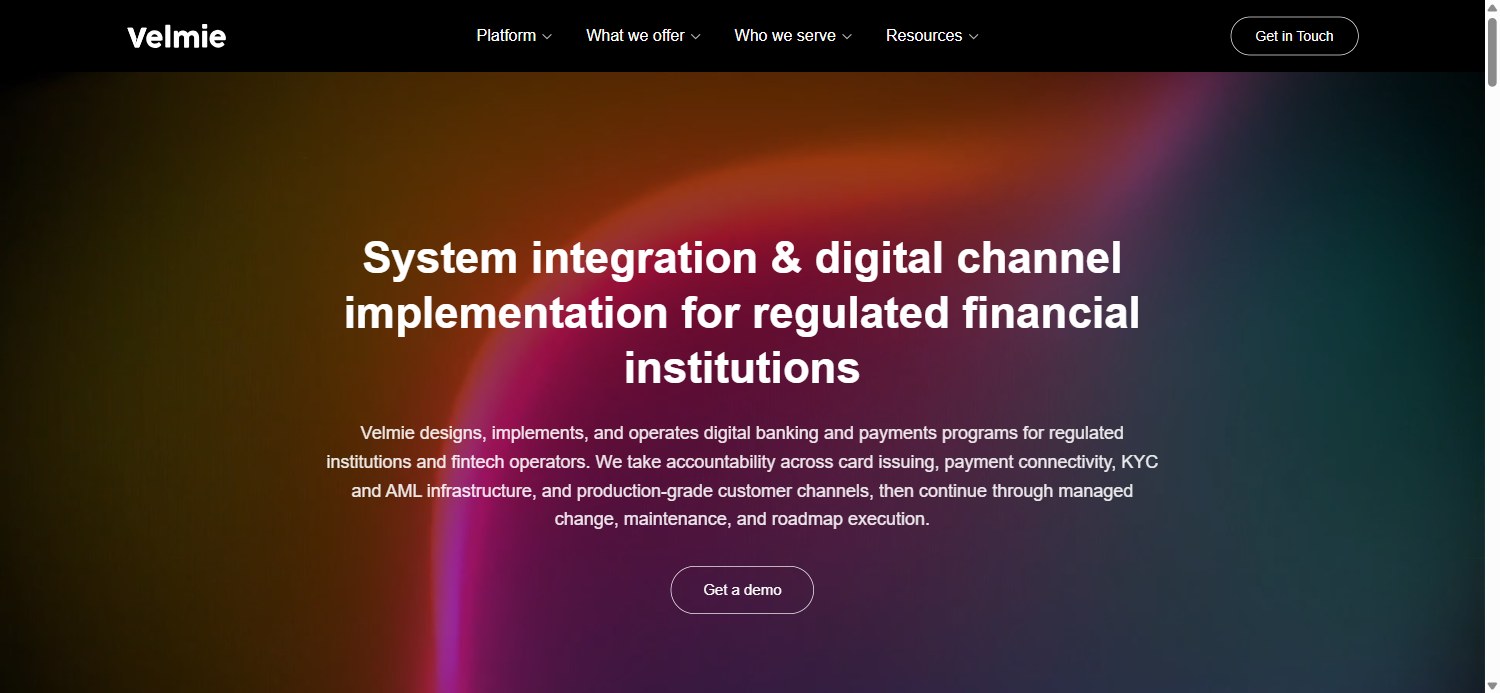
Velmie provides a digital banking platform (a configurable business capability layer, an API middleware and orchestration layer, and mobile and web channels) and designs, implements and operates digital banking and payments programs through what it calls a dedicated product team model, with program ownership, release governance and managed evolution. Scope includes card issuing and processing, payment rails and cross-border flows, KYC and AML integrations and back-office tooling. Offices are listed in New York, London, Dubai, Vilnius and Warsaw. Source: velmie.com, checked 5 November 2026.
Ideal For
- Banks and fintechs launching account, card or payment programs
- Buyers who want the platform and the operating team from one supplier
- Programs that need card issuing, payment rails and KYC/AML integrations ready to configure
Top Features
- Platform Plus Team: both in one engagement.
- Ready Integrations: payment rails, card issuing and KYC/AML.
- Stated Accountability: program ownership through implementation and post-launch operations.
- Multi-Region Presence: European, US and Gulf markets.
Why It Is a Strong Alternative
Velmie is the clearest platform-led option on this list, and for a standard banking product that is a real advantage. CloudGeometry does not supply a banking platform; it runs the lifecycle of the system you already have. The two are rarely in the same shortlist, and that is the point of separating the layers.
Pros
- Fastest route to a standard account or card product
- Operating model described with release governance built in
- Multi-region presence
Cons
- The platform is the architecture; bespoke systems are integrations around it
- Headcount, headquarters and pricing are not stated
- Less relevant where the asset is an existing bespoke codebase
Pricing
On request.
Final Verdict
The platform choice for standard banking and payment launches.
Why Does CloudGeometry Work Across FinTech Use Cases?
1. CloudGeometry When You Have Evaluated a Delivery Firm and the Question Is Control
Capacity models leave governance with you. That is fine when you have the review capacity; it is a problem when the backlog outruns it. AI-MSL puts the specification, the impact analysis and the sign-off inside the service, so adding throughput does not mean adding review load on your own team.
2. CloudGeometry When Someone Outside Engineering Asks What Changed
In fintech that someone is a risk function, an auditor, a partner bank or a regulator. Each change through AI-MSL carries the request, the approved scope, the specification, the sign-offs by name and the test results. What that record satisfies is your risk function's call; producing it is ours.
3. CloudGeometry for Regulatory Logic That Lives in Code Nobody Wants to Touch
KYC flows, payment integrations and reporting pipelines accumulate years of rules. AppGraph models the code, dependencies and workflows a change touches, so the impact of a change to a reporting job or a payment path is analyzed before it is built rather than discovered in production.
4. CloudGeometry for Legacy Modernization Without a Rewrite
Modernization runs through the same lifecycle as feature work: incremental, specified change by change, each one approved and recorded. The application modernization page describes the approach for systems that cannot afford a big-bang replacement.
5. CloudGeometry for Knowledge Retention Through Attrition
The engineer who knew the settlement module leaves. With a capacity partner, their knowledge leaves too. AppGraph keeps the system's structure, dependencies and history in the system, so the next change starts from the current state rather than from a fresh discovery exercise.
6. CloudGeometry for Adding AI Capability to an Existing Product
Fintech products are adding assistants, document processing and decision support. Those features change a system that is already under regulatory scrutiny. Running them through a governed lifecycle means the AI feature arrives with the same record as any other change.
When Does It Make Sense to Change Your Delivery Model?
Three signals tend to appear together. The backlog is growing while the team is flat. A disproportionate share of senior time goes to explaining what changed rather than changing it. And system knowledge is concentrated in a few people whose departure would be a risk event. Any one of these can be managed inside a capacity model. All three together usually mean the model, not the team, is the constraint.
The opposite signals matter as well. If you are building a new product, if your team has spare review capacity, or if your main need is a standard banking core, a delivery firm or a platform vendor is the better fit, and several are on this list.
What Makes a Good FinTech Software Development Partner?
Which Layer of the Stack It Operates At
Capacity, platform or lifecycle. Each is legitimate; comparing across them produces false conclusions.
Supervised or Autonomous
Ask who signs off before a change reaches production and whether that person is named. Autonomy claims are a warning sign in a regulated environment. AI-MSL runs AI execution under expert supervision; a CloudGeometry engineer approves every gate.
Works on Brownfield Production Systems
Ask for an example of the partner changing a system it did not build. Launch references do not predict brownfield performance.
Can You Trace a Deployed Change to a Requirement
Ask to see one real change record. If it has to be assembled from tickets, commits and chat messages, it will not survive the first serious question.
Does System Knowledge Persist Between Sessions and People
Ask what the partner keeps about your system between engagements, and whether it stays in your environment.
What Unit Are You Buying, and What Does Exit Look Like
Person-months, a platform license or a change. Ask what you own and what remains when the engagement ends. With AI-MSL the code stays in your repositories and there is no proprietary runtime to leave.
How to Choose the Right FinTech Software Development Service for Your Needs
1. Write Down Which Layer You Are Buying
One sentence: we need capacity, we need a platform, or we need someone to run the change lifecycle for this system. Most bad shortlists come from skipping this step.
2. Separate Launch From Lifecycle
Launch partners and lifecycle partners are rarely the same company. Decide which phase you are in and shortlist for that phase.
3. Ask for the Change Record, Not the Case Study
A case study tells you the project shipped. A change record tells you how the next one will.
4. Check the Commercial Unit Against Your Constraint
If your constraint is review capacity, a headcount model adds to it. If your constraint is cost predictability, ask how the unit is estimated and approved.
5. Evaluate Against a Real System
Give the shortlist one real backlog item on your real codebase, with your real reviewers. The pilot is how CloudGeometry runs this; the other companies on this list will usually agree to an equivalent.
Everything You Need to Know About FinTech Software Development Services
FinTech software development services cover the design, build, modernization and maintenance of software that moves, stores, lends or reports on money: digital banking, payments, lending, trading, wealth management, insurance and the compliance infrastructure around them. The market in 2026 includes global delivery organizations, fintech-only specialists, platform vendors and managed lifecycle services, and the right choice depends on whether you are launching something new or changing something that already runs.
← scroll to see all columns →
| Category | Key Considerations |
|---|---|
| Three layers, not one list | Delivery organizations supply teams (EPAM, DataArt, Intellias, Itexus, Django Stars); platform vendors supply a core plus a team (Velmie, DashDevs); a managed lifecycle runs each change end to end (CloudGeometry); Praxent sits between transformation consulting and agentic engineering |
| Best overall option | CloudGeometry for an existing fintech system under change pressure; DashDevs or Velmie for a new launch; EPAM, DataArt or Intellias for a large defined program; Itexus or Django Stars for a specialist build |
| What fintech changes | Every change touches money and will be questioned by someone outside engineering; the change record (request, approved scope, specification, named sign-offs, test results) is the deciding artifact |
| The six questions to ask | Which layer; supervised or autonomous; brownfield fit; requirement-to-deployment traceability; does system knowledge persist; what unit are you buying and what does exit look like |
| Pricing models | Time-and-materials and statements of work (EPAM, DataArt, Intellias, Django Stars); published project ranges (Itexus); outcome-linked fee (Praxent, company wording); platform plus team (Velmie, DashDevs); published plans with a pilot on one backlog item (CloudGeometry) |
| Ease of starting | Delivery firms: a statement of work and a team ramp; platform vendors: configuration of the core; CloudGeometry: one real backlog item through the pilot, then the onboarding assessment |
| Must-have capabilities | Named sign-off before production; brownfield compatibility; a change record produced as part of the work; durable system knowledge; code that stays in your repositories |
| Mistakes to avoid | Shortlisting a launch partner for a lifecycle problem; comparing a platform to a delivery firm on price; accepting a case study in place of a change record; letting governance depend on your own spare review capacity |
For existing systems, the deciding factors are who signs off on each change, whether a deployed change traces back to its requirement, and where system knowledge lives when people move on. CloudGeometry's AI-MSL is built around those three questions; the other companies on this page answer them in different ways, each suited to a different situation.
Already Have a Development Partner? Add the Layer It Cannot Reach
Most fintech companies already work with one of the firms above or someone like them, and that relationship often continues. What AI-MSL adds is the lifecycle layer for the system that needs it most: one real backlog item from your queue, specified, built, tested and recorded, with our engineers signing off every change, in about a week. The pilot includes $2,000 in Dev credits on us.
Start a pilot on one backlog item or compare the AI-MSL plans.
FAQs About FinTech Software Development Services
What do fintech software development services include?
Design, build, modernization, maintenance and operations for software that handles money: digital banking, payments, lending, trading, wealth management and insurance, plus the KYC, AML, reporting and reconciliation systems around them. Some providers supply teams, some supply platforms, and some run the change lifecycle as a managed service.
How much does fintech software development cost?
Most providers quote on request. Of the companies on this page, Itexus publishes indicative ranges on its website, and CloudGeometry publishes its plans. Treat any figure on a comparison site as unverified until you see it on the provider's own page.
Should a fintech company outsource development or build in-house?
Both work, and the better question is where governance sits. In-house teams keep control but hit capacity limits; outsourced teams add capacity but leave review with you. A managed lifecycle keeps the sign-off inside the service while the code stays in your repositories.
What is AI-MSL?
AI-MSL is CloudGeometry's AI-managed software lifecycle, delivered as an integrated platform and managed service. AI executes the lifecycle stages, from requirements to release, grounded in a maintained model of your system, and CloudGeometry engineers approve each gate before a change ships.
Does AI-MSL run without human involvement?
No. AI performs the high-volume lifecycle work and CloudGeometry engineers approve every gate before a change ships. Production signals feed back into the lifecycle as candidate improvements, and a person decides which of those proceed.
Is CloudGeometry certified for financial services?
CloudGeometry does not make compliance or certification claims on this page. What it provides is a complete, timestamped record of every change from requirement to deployment, named sign-offs at each gate, and work that happens in your repositories and your cloud account. Whether that record meets a particular obligation is a determination your risk function makes.
Which companies on this list are best for a new fintech product launch?
DashDevs and Velmie are organized around launches with a pre-built core or platform. Itexus and Django Stars also build new products. CloudGeometry does not take greenfield work.
Which companies are best for an existing fintech system?
CloudGeometry is built for that case. EPAM, DataArt and Intellias also list modernization of existing systems as a service, delivered through their own teams inside your process.
How is a managed software lifecycle different from a dedicated team?
A dedicated team is a capacity unit: people working inside your process, with your governance. A managed lifecycle is an outcome unit: each change is specified, approved, built, tested and recorded by the service, with its own engineers accountable at each gate.
How do I evaluate a fintech development partner before committing?
Give them one real backlog item on your real system and look at the change record they hand back. CloudGeometry's pilot is structured for exactly that test.
Last updated: November 5, 2026