Compare the best AI transformation services in 2026: CloudGeometry, Accenture, Thoughtworks, Fractal and more, by layer, sign-off model and brownfield fit.
Key Takeaways (TL;DR)
- Best Overall for AI Transformation of Software You Already Run: CloudGeometry delivers AI transformation as an AI-managed software lifecycle. The transformation happens change by change inside your existing systems: each change is specified from business intent, built and tested by AI, and approved by a named CloudGeometry engineer before it ships, in your repositories and your cloud account. That answers the question most buyers are asking in 2026: how do we transform the software we run today without a rewrite, a new platform or a multi-year program?
- This List Is Not One Category: the nine companies below operate at four different layers. Consultancies run programs, delivery organizations supply teams and platforms, AI-native specialists embed engineers, and one runs the change lifecycle of your existing software as a managed service. Decide which layer you are buying before you compare names.
- What AI Transformation Changes About the Choice: most transformation failures are not model failures. They are the gap between a pilot that worked and a production system nobody is accountable for changing. The partner that matters is the one who owns what happens after the roadmap.
- Price What You Can Compare: none of the eight third-party companies on this page publishes its rates, and every pricing cell below says so rather than guessing. CloudGeometry publishes its plans.
- How to Choose: ask six questions. Which layer does the partner operate at; is AI execution supervised or autonomous; does it work on brownfield production systems; can you trace a deployed change to its requirement; does system knowledge persist between sessions and people; and what unit are you buying.
- Who This Page Is Not For: organizations that need an enterprise-wide operating model redesign, and teams building a brand-new AI product with no production system yet. Several firms below serve both well. AI-MSL is built for software that already runs.
Table of Contents
- Top AI Transformation Services in 2026 at a Glance
- What AI Transformation Buyers Are Choosing Between in 2026
- Best AI Transformation Services: In-Depth Review and Comparison
- Why Does CloudGeometry Work Across AI Transformation Use Cases?
- When Does It Make Sense to Change Your Delivery Model?
- What Makes a Good AI Transformation Partner?
- How to Choose the Right AI Transformation Service for Your Needs
- Everything You Need to Know About AI Transformation Services
- Already Running a Transformation Program? Add the Layer It Cannot Reach
- FAQs About AI Transformation Services
Top AI Transformation Services in 2026 at a Glance
"AI transformation services" is a label that covers a strategy workshop, a 5,000-person program and a two-engineer pilot. The table below sorts the nine companies by the layer they operate at, because that decides what you are comparing. "Who signs off" records how each company describes release control in its own words, or who holds it by default. "Brownfield fit" is our reading of how each company positions itself toward software that already runs in production.
← scroll to see all columns →
| Company | Layer | Best For | Who Signs Off | Brownfield Fit | Pricing |
|---|---|---|---|---|---|
| 01CloudGeometryBest overall | AI-managed software lifecycle: integrated platform and managed service | Companies transforming software they already run, one governed change at a time | AI executes each stage; a named CloudGeometry engineer approves every gate | Built for it; brownfield only | Plans published; pilot on one backlog item |
| 02Accenture | Large consultancy | Global enterprises running reinvention programs across strategy, technology and operations | Client program governance with Accenture teams embedded | Transformation programs that include modernization work | On request |
| 03Capgemini | Large consultancy | Large organizations that want strategy, design, engineering and operations from one partner | Client program governance with Capgemini teams embedded | Transformation programs that include modernization work | On request |
| 04BCG X | Consultancy build unit | Enterprises that want strategy consulting and a product-build team in the same engagement | Client governance; multidisciplinary BCG X teams build | Positioned around new products, platforms and ventures | On request |
| 05EPAM Systems | Delivery organization with an AI practice | Large enterprises that want a listed engineering partner with deep bench strength | Client-run governance with EPAM teams embedded | Strong on large modernization programs | On request |
| 06Thoughtworks | Delivery organization with an AI practice and platforms | Enterprises modernizing core systems and moving delivery onto an agentic development model | Client-run governance; Agent/works offered as a control plane for agents (company wording) | Legacy modernization is a named service | On request |
| 07Grid Dynamics | Delivery organization with AI-native platforms | Enterprises that want AI-native platforms plus embedded engineers | Client-run governance; forward-deployed engineers embedded in the client team (company wording) | Platforms and engineering applied to existing enterprise estates | On request |
| 08Fractal | AI-native specialist | Large enterprises redesigning business functions around AI, data and decision systems | Client-run governance; Fractal teams deliver from strategy through implementation | Function-level transformation rather than codebase-level change | On request |
| 09Tribe AI | AI-native boutique | Companies that want forward-deployed engineers to take one AI problem to production | Client-run governance; Tribe engineers "own the problem end to end" (company wording) | Works against the client's real systems and constraints (company wording) | On request |
Every third-party fact on this page comes from the company's own public website, checked on 5 November 2026. Where a company does not state something, the table says "on request" or leaves it out.
What AI Transformation Buyers Are Choosing Between in 2026
A search for "best AI transformation services" returns four kinds of company, and most lists present them as interchangeable. Each is organized around a different unit of work, and the unit decides what you pay for and who is accountable when something ships.
Large Consultancies
These firms run transformation as a program: strategy, operating model, change management, technology selection and delivery. Accenture, Capgemini and BCG X all describe themselves this way, at different scales. The unit of work is the program, and release control for any particular system sits with whichever team the program assigns.
Delivery Organizations With an AI Practice
These firms supply engineering teams and, increasingly, their own AI platforms. EPAM, Thoughtworks and Grid Dynamics have all added an AI practice or an agentic development platform to an engineering services business. You own the roadmap and the release process; they bring capacity and platforms. The commercial unit is usually a person-month or a statement of work.
AI-Native Specialists
Fractal and Tribe AI were built around AI rather than adding it. They embed specialists to identify the problem, build the system and get it adopted. The unit is the problem, or the business function. What happens to the resulting capability once it is part of a production codebase that keeps changing is the question to ask in reference calls.
Managed Lifecycle Services
CloudGeometry's AI-MSL takes a different approach. It runs the change lifecycle of software you already operate: a change is specified from business intent, its impact is analyzed against a continuously maintained model of your system, it is implemented and tested by AI, and a CloudGeometry engineer approves each gate before it moves on. The unit is a change, not a program and not a person. AI transformation, in this model, is what happens to your software over hundreds of governed changes rather than in one initiative.
Different approaches optimize for different outcomes. A program is right when the transformation is organizational. A delivery organization is right when you know what to build and need capacity. An AI-native specialist is right when the problem is new. A managed lifecycle is right when the hard part is changing a system that already exists without losing control of what changed.
Best AI Transformation Services: In-Depth Review and Comparison
1. CloudGeometry
Overview
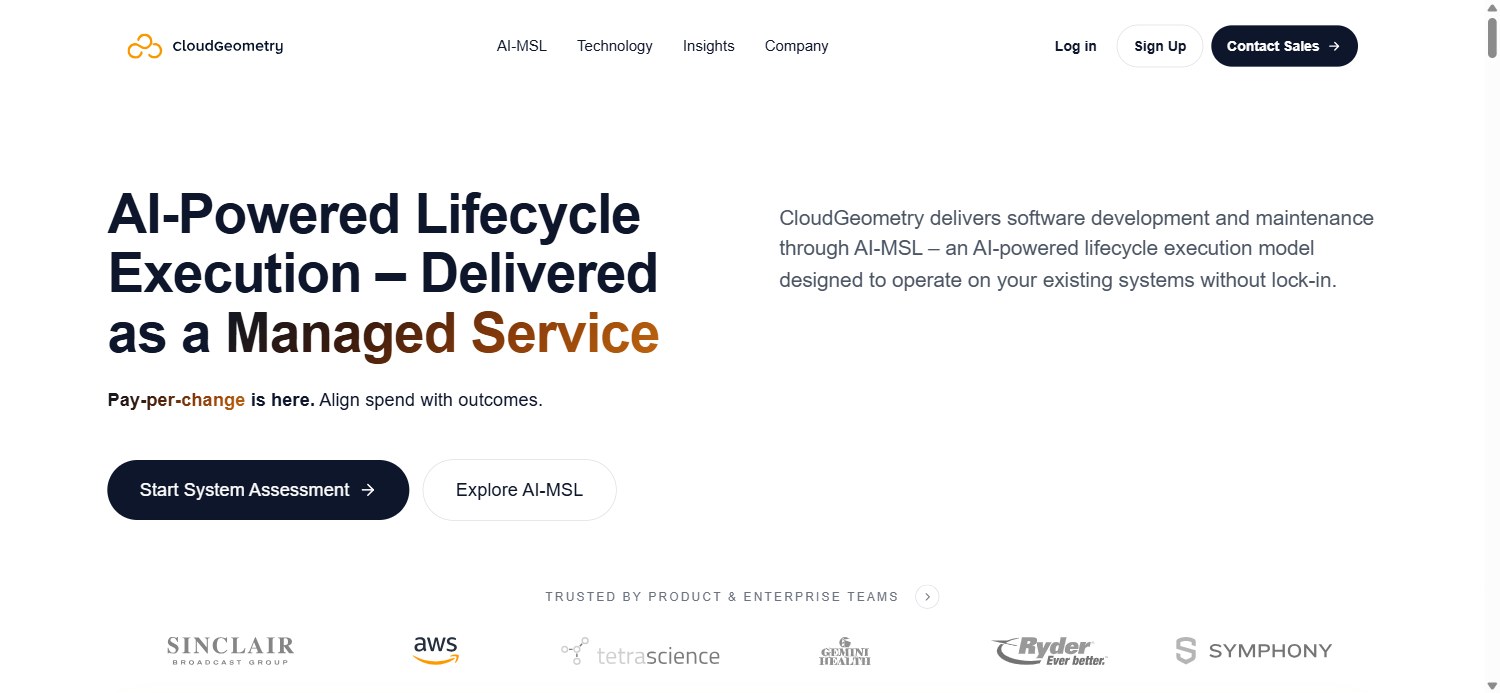
CloudGeometry is a Sunnyvale, California engineering company whose AI transformation services are delivered through AI-MSL, an AI-managed software lifecycle: an integrated platform and managed service. The platform keeps a continuously maintained model of your system, called AppGraph, so every change is specified and implemented with knowledge of the code, dependencies and workflows it touches. The managed service puts an AI Lifecycle Manager on the engagement and AI-MSL Engineers on the approval gates.
The premise is that AI transformation of existing software is a sequence of changes, and the right way to govern a sequence of changes is a lifecycle, not a program. You submit a change request. AI-MSL turns it into requirements, a specification and an impact analysis. Once you approve, AI executes implementation, testing and documentation, and a named CloudGeometry engineer approves release readiness before anything merges. Every action in between is logged with timestamp, actor and reasoning.
CloudGeometry works only on brownfield systems: software that already runs in production and has to keep changing. The work happens in your repositories and your cloud account. CloudGeometry is an Anthropic partner for Claude Code and an AWS consulting partner; the models and tools run inside the lifecycle rather than being the product.
Ideal For
- Companies with production software that is several years old, a backlog the team cannot clear, and a board asking what AI is doing for the product
- Owners and operators whose engineering runs through an outside vendor or remote team and who want one accountable party per change
- CTOs and VPs of Engineering who have run an AI pilot and need the result to land in a system that carries years of business logic
- Teams that want to try the model on one real backlog item before committing to anything larger
Top Features
- One Governed Sequence: requirements, specifications, implementation, test and release run as a single lifecycle rather than a queue of hand-offs between teams.
- AppGraph System Knowledge: a maintained model of the code, dependencies, workflows and history of your system, so knowledge does not leave when an engineer or a consultant does.
- Named Sign-Off at Every Gate: every action is logged with timestamp, actor and reasoning, and a CloudGeometry engineer approves before a change ships.
- Your Repositories, Your Cloud Account: work happens in your Git repositories and your cloud account, with no proprietary runtime to migrate onto.
- Transformation as a Series of Changes: AI assistants, agents and automation are built inside the software you already ship, each one specified, approved and recorded.
Why We Are the Right Fit for AI Transformation
We say "fit" rather than "best" on purpose. AI-MSL is built for one situation: software that already runs, that has to change, and where the change has to be accountable to someone outside engineering. If that is your situation, the lifecycle model gives you AI execution, a change record and a named sign-off without a program layer on top. If your transformation is organizational, or your product does not exist yet, several companies on this list are a better match, and we say so in their entries.
Pros
- One accountable party for each change from intent to release
- System knowledge persists between changes and between people
- Low-commitment entry: the pilot runs one real backlog item in about a week
- No proprietary runtime to migrate onto; the code is yours, in your repositories
Cons
- Not offered for greenfield products with no existing system
- Not an organizational transformation program; it does not redesign operating models or run change management
- Not self-serve: engagements are scoped with a CloudGeometry engineer, and the onboarding assessment comes first
- A smaller company than the global firms on this list, which matters to buyers with long procurement cycles
Pricing
Plans are published on the AI-MSL plans page. Each change is estimated and approved before it is built. The pilot includes $2,000 in Dev credits for the first backlog item.
Final Verdict
The strongest option on this list for a company whose AI transformation has to happen inside software it already runs. Not the option for a program that spans the whole enterprise.
2. Accenture
Overview
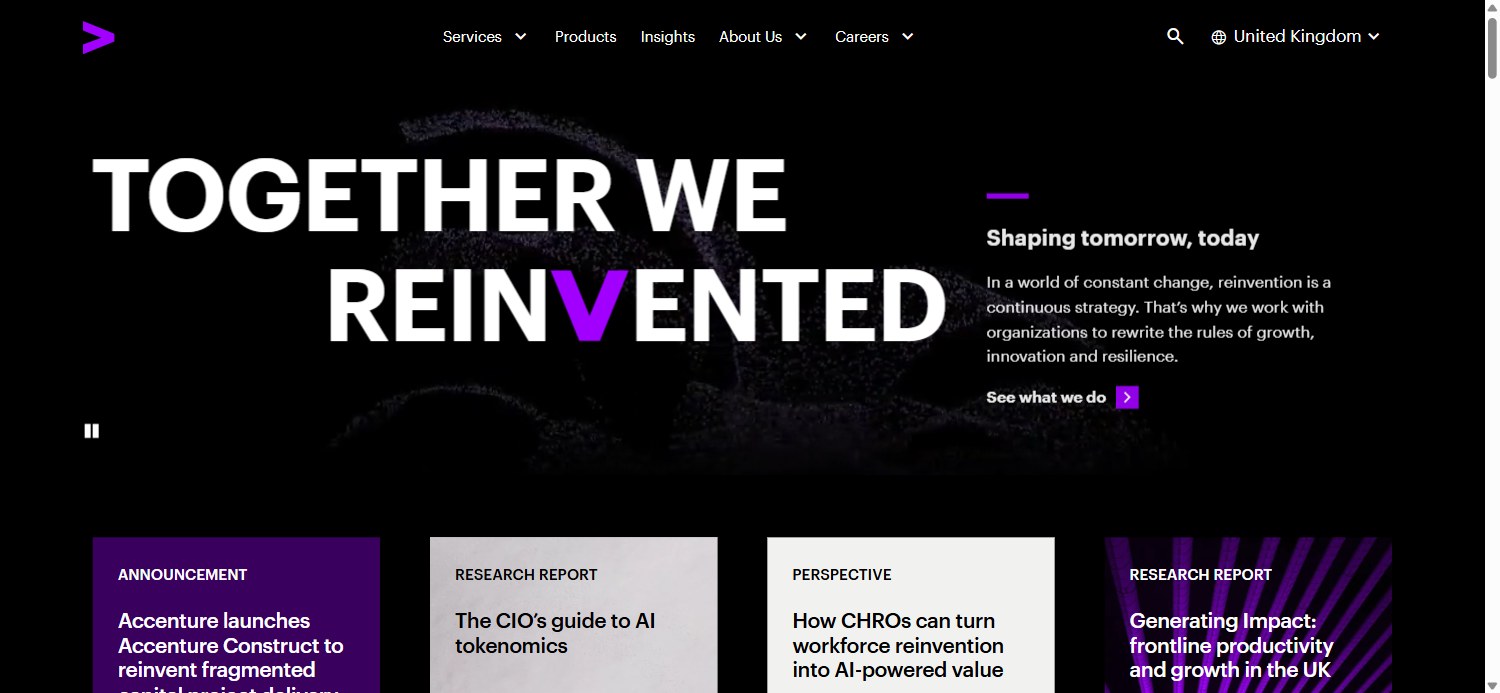
Accenture describes itself as "the reinvention partner of choice" and groups its capabilities under Reinvention Services, which "brings together the full breadth of Accenture." Its site states 814,000 employees worldwide, offices and operations in 52 countries and more than 200 cities, and more than 9,000 clients served across more than 120 countries. Its data and AI services are organized as Industrial AI, Data Services, Generative AI, AI Strategy and Value, Responsible AI, Technology Sovereignty, AI Talent and Workforce, and Accenture AI Refinery, which the company describes as "a comprehensive platform that addresses the barriers to scaling and drives reinvention through AI."
The company lists partners including Anthropic, AWS, Databricks, Google, Microsoft, Nvidia, OpenAI, Salesforce and SAP. Source: accenture.com, checked 5 November 2026.
Ideal For
- Global enterprises running reinvention programs that span strategy, operations and technology
- Boards that want one firm accountable for a multi-year AI program
- Buyers who need established procurement pathways and alliances across every major cloud and model provider
Top Features
- Reinvention Services: strategy, consulting, technology, operations and industry practices under one engagement structure.
- AI Refinery: a platform the company positions for scaling AI across the enterprise.
- Industrial AI: a named service line for operations that "sense and respond in real time" (company wording).
- Partner Ecosystem: alliances with the major cloud, data and model providers.
Why It Is a Strong Alternative
If the transformation is enterprise-wide and the board wants one firm accountable for strategy, change and delivery together, Accenture is built for that. CloudGeometry takes a different approach: it is built for the company whose transformation is a steady stream of changes to systems it already runs. Our Accenture alternatives roundup goes into the trade-off in detail.
Pros
- Breadth of practice and industry coverage at the largest scale on this list
- Strategy, technology and workforce services in one engagement
- Alliances with every major cloud and model provider
Cons
- Pricing and engagement terms are not published
- Program-scale engagements suit large enterprises better than a mid-market backlog
- System knowledge lives with the program team and leaves with it
Pricing
On request.
Final Verdict
The default choice for an enterprise-wide reinvention program. Mid-market companies often find the scale is more than they need.
3. Capgemini

Overview
Capgemini describes itself as "a leading advisor and transformation partner to companies around the world" that "helps businesses imagine their future and make it real with AI, technology and people." Its site states 420,000 people in more than 50 countries, revenue of 22.5 billion euros in 2025, and almost 60 years of enabling business transformation through technology. Its work covers strategy, design, operations management and engineering, with data and artificial intelligence listed among its services.
The company states that it works with most of the 200 largest public companies on the Forbes Global 2000 list. Source: capgemini.com, checked 5 November 2026.
Ideal For
- Large organizations that want strategy, design, engineering and operations from one global partner
- Enterprises that need a transformation partner with a long history and broad industry coverage
- Buyers who want AI delivered as part of a wider technology and operations program
Top Features
- Full-Spectrum Transformation: strategy, design, operations management and engineering in one firm.
- Data and AI Services: a named service line alongside cloud, software and digital engineering.
- Global Scale: 420,000 people in more than 50 countries (company figures).
- Research Arm: the Capgemini Research Institute publishes on AI adoption.
Why It Is a Strong Alternative
Capgemini fits a transformation that needs operations, engineering and strategy to move together at scale. CloudGeometry's model differs in where accountability sits: the lifecycle, the change record and the sign-off are CloudGeometry's to run, change by change, inside your existing systems.
Pros
- Breadth from strategy through operations
- Scale and history that procurement teams recognize
- AI positioned within a wider engineering and operations capability
Cons
- Pricing and engagement terms are not published
- Specific AI offerings are not described in detail on the pages checked
- Program scale suits large enterprises better than a single system under change pressure
Pricing
On request.
Final Verdict
A credible choice for a large organization that wants AI as one strand of a wider transformation program.
4. BCG X

Overview
BCG X describes itself as "the tech build and design unit of BCG." Its site states nearly 3,000 experts in 80 cities, more than 82 patents and patents pending, and more than 30 technology and business partnerships. Its service lines are AI and GenAI, Customer Experience for Growth, Delivery, Large-Scale Digital Platform and Product Builds, and Venture and Business Builds. It also runs the BCG X AI Science Institute and maintains a product library that includes Smart Banking AI, Supply Chain AI, Retail AI and Auto AI.
Named client stories on the page include Reckitt and Rio Tinto. Source: bcg.com, checked 5 November 2026.
Ideal For
- Enterprises that want strategy consulting and a product-build team in the same engagement
- Companies launching a new AI-enabled product, platform or venture
- Buyers who value pre-built industry solutions as a starting point
Top Features
- Strategy and Build Together: BCG's consulting practice with a dedicated build unit.
- Product Library: industry solutions the company positions as starting points for banking, retail, supply chain and automotive.
- Venture and Business Builds: an end-to-end approach to launching new products and businesses (company wording).
- AI Science Institute: research collaboration with universities and industry R&D teams.
Why It Is a Strong Alternative
BCG X optimizes for building something new with a strategy case behind it. CloudGeometry optimizes for the years after something has been built, when the system is bespoke and every change needs a record.
Pros
- Strategy and engineering in one team
- Named enterprise client stories
- Pre-built solutions that shorten the start of a build
Cons
- Pricing is not published
- Positioned around new builds and ventures rather than continuous change to existing systems
- Pre-built solutions introduce their own architecture into your estate
Pricing
On request.
Final Verdict
A strong choice for an enterprise that wants a strategy firm to build the new thing.
5. EPAM Systems
Overview
EPAM Systems is a publicly listed global engineering and consulting firm with roughly 52,000 employees across more than 50 countries, per the company's own reporting. Its services span software engineering, cloud, data, AI and digital product design, delivered through distributed engineering teams with onshore client leadership. Source: epam.com, checked 5 November 2026.
Ideal For
- Large enterprises that want a listed engineering partner with established procurement pathways
- Companies planning multi-year modernization programs that need deep bench strength
- Buyers who need every engineering discipline, plus AI, from one vendor
Top Features
- Scale: every engineering discipline an enterprise needs, in one firm.
- Global Delivery: distributed engineering with onshore client leadership.
- AI Within Engineering: AI consulting and platform work delivered through the same teams that build and run the software.
- Industry Practices: vertical practices across financial services, healthcare, retail and others.
Why It Is a Strong Alternative
If the program is large, long and needs a vendor a procurement team already knows, EPAM is a safe choice. CloudGeometry is built for the mid-market company whose transformation is a steady stream of changes to one system. Our EPAM alternatives roundup covers the trade-off in more depth.
Pros
- Breadth and depth of engineering talent
- Procurement, security and contracting at enterprise standard
- AI delivered by the same organization that builds the software
Cons
- Commercial model is headcount-based, so cost tracks team size rather than output
- System knowledge lives with the engagement team and leaves with it
- Engagement scale suits large programs better than a mid-market backlog
Pricing
On request.
Final Verdict
The default enterprise engineering choice. Mid-market companies often find the scale is more than they need.
6. Thoughtworks
Overview
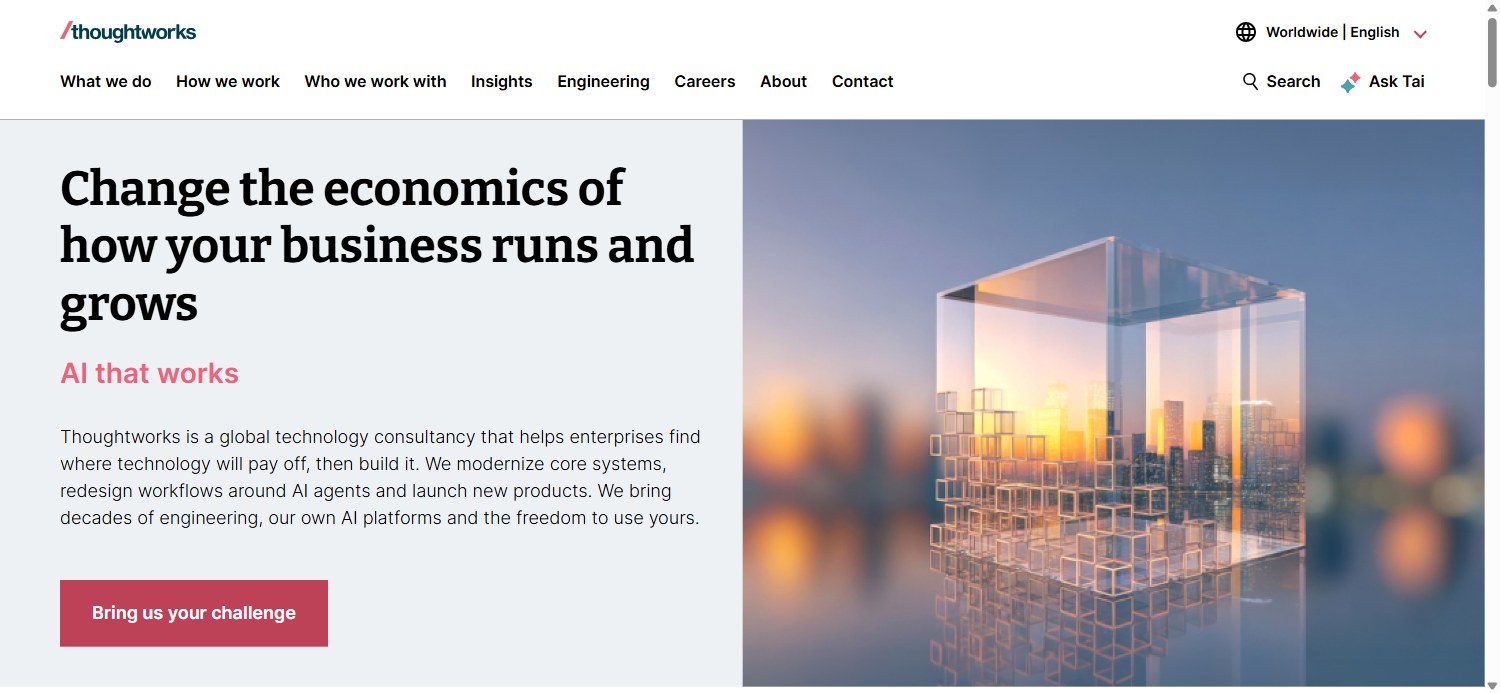
Thoughtworks describes itself as "a leading global technology consultancy" that helps enterprises "find where technology will pay off, then build it." Its site states that it was founded in Chicago in 1993 and has more than 10,000 employees across 47 offices in 18 countries. Its AI offerings include AI/works, described as its agentic development platform, and Agent/works, described as "a control plane that governs, observes, and cost-manages AI agents" across models, frameworks and clouds. Its legacy modernization service includes moving delivery onto an agentic software development lifecycle, and clients can use Thoughtworks platforms or keep their existing tools.
Named clients on its site include Bosch, PayPal, Bayer and the US Department of Veterans Affairs. Technology partners listed include AWS, Google Cloud, Microsoft Azure, Databricks, Anthropic and Nvidia. Source: thoughtworks.com, checked 5 November 2026.
Ideal For
- Enterprises modernizing core systems that want delivery to move onto an agentic development model
- Technology leaders who want advisory and implementation from the same consultancy
- Organizations that want a governance control plane for AI agents they already run
Top Features
- AI/works: the company's agentic development platform for building and running enterprise systems.
- Agent/works: a control plane for governing, observing and managing the cost of AI agents (company wording).
- Legacy Modernization: a named service that includes the move to an agentic delivery lifecycle.
- Technology Advisory: strategists and distinguished engineers who identify where AI will pay off before implementation.
Why It Is a Strong Alternative
Thoughtworks is the closest company on this list to CloudGeometry in intent: both put an agentic software lifecycle at the center of modernization. The difference is the operating model. Thoughtworks offers platforms and consultants so that your organization runs the lifecycle; AI-MSL runs the lifecycle as a managed service, with CloudGeometry engineers on the gates. A buyer who wants to build the capability in-house will prefer the former; a buyer who wants it delivered will prefer the latter.
Pros
- A named agentic development platform and a named agent governance platform
- Advisory and engineering from one firm, with a long modernization track record
- Named enterprise clients across several industries
Cons
- Pricing is not published
- Who approves AI-generated changes is not described; release control sits with the client
- Platform adoption means the client organization takes on running the lifecycle
Pricing
On request.
Final Verdict
A serious option for an enterprise that wants to run its own agentic delivery lifecycle with a consultancy's help.
7. Grid Dynamics
Overview
Grid Dynamics is a publicly listed engineering and consulting company headquartered in San Ramon, California. Its site organizes its work into consulting, engineering (artificial intelligence, AI and data platforms, cloud and product engineering, physical AI and robotics, and managed services) and a set of platforms it calls Grid Dynamics AI Native, or GAIN, covering agentic commerce, AI SDLC and physical AI. The company states that its platforms are "delivered by our Forward Deployed Engineers (FDE), embedded inside your team."
Client logos on the page include Google, Macy's, Jabil and Merck. Source: griddynamics.com, checked 5 November 2026.
Ideal For
- Enterprises that want AI platforms plus engineers embedded in their teams
- Companies with a formal procurement process
- Buyers who want consulting, engineering and managed services from one listed vendor
Top Features
- GAIN Platforms: AI-native platforms for agentic commerce, AI SDLC and physical AI.
- Forward-Deployed Engineers: platform delivery through engineers embedded in the client team (company wording).
- Managed Services: listed alongside engineering, so operation after delivery is available.
- Industry Coverage: seven named verticals with case material in each.
Why It Is a Strong Alternative
Grid Dynamics fits a company that wants an AI-native platform and the engineers to install it inside its own teams. CloudGeometry's model differs in where the lifecycle runs: AI-MSL runs each change through its own governed sequence, with the record and the sign-off inside the service.
Pros
- Named platforms including one for the AI software development lifecycle
- Embedded engineering with managed services available afterward
- Recognizable enterprise client logos
Cons
- Headcount, founding year and pricing are not stated
- Platform-led delivery means the platform becomes part of your architecture
- Governance and release control stay with the client team
Pricing
On request. The company accepts RFI, RFP and RFQ submissions through its site.
Final Verdict
A practical choice for an enterprise that wants platforms and embedded engineers from a listed vendor.
8. Fractal
Overview
Fractal describes itself as "a globally recognized enterprise AI company" that helps organizations transform business functions through "AI-led transformation, strong AI foundations, and human-centered adoption." Founded in 2000 and publicly listed in 2026, it states more than 6,000 employees and names subsidiaries in the United Kingdom, the United States and Australia. Its three service areas are AI-led Transformation (redesigning critical enterprise functions using AI, data and domain expertise), AI Foundations (data, agentic systems, evaluation layers and governance) and AI Work and Workforce (human-AI workflows for adoption). Industries listed include consumer goods, retail, life sciences, financial services, insurance and industrials.
The company states that it is a Preferred Services Partner in the Claude Partner Network. No clients are named on the pages checked; case studies describe them generically. Source: fractal.ai, checked 5 November 2026.
Ideal For
- Large enterprises redesigning a business function around AI
- Companies that want decision-system work from a firm that has done only AI for two decades
- Buyers in consumer goods, retail, life sciences or financial services with a function-level mandate
Top Features
- AI-Led Transformation: a named service area for redesigning enterprise functions.
- AI Foundations: data, agentic systems, evaluation layers and governance as a service area.
- Workforce Adoption: a service area for human-AI workflow design and adoption.
- Products and Platforms: Cogentiq and LLM Studio alongside the services.
Why It Is a Strong Alternative
Fractal is a good fit when the transformation is a business function and the deliverable is a decision system with the workforce trained to use it. CloudGeometry fits when the transformation is a codebase: the production software behind the function, which has to keep changing with a record of each change.
Pros
- AI-only history since 2000 with a function-level transformation model
- Explicit adoption and workforce service alongside the technology work
- Publicly listed, with the disclosure that brings
Cons
- Pricing and engagement terms are not published
- No named clients on the pages checked
- Function-level engagements leave the change lifecycle of the underlying software with the client
Pricing
On request.
Final Verdict
A credible AI-native choice for a function-level transformation in a large enterprise.
9. Tribe AI
Overview
Tribe AI describes its model as pairing "deep industry expertise with forward-deployed engineers who own the problem end to end," in three stages it calls Map, Build and Activate: identify the problems where your data and institutional knowledge give you an advantage, build with engineers who "work inside your org, against your real systems and constraints," and redesign how people and agents work so early wins spread. The company lists offices in New York, San Francisco and Lisbon. Headcount, founding year and pricing are not stated. Source: tribe.ai, checked 5 November 2026.
Ideal For
- Companies that want a small team of forward-deployed engineers to take one AI problem to production
- Leaders who want the work done inside their own systems rather than on a vendor platform
- Organizations whose advantage is proprietary data and institutional knowledge
Top Features
- Forward-Deployed Engineering: engineers embedded in the client organization who own the problem to production.
- Map, Build, Activate: a three-stage model from problem selection through adoption.
- Frontier Lab Relationships: direct partnerships with model developers (company wording).
- Adoption Focus: explicit work on how people and agents work together after launch.
Why It Is a Strong Alternative
Tribe AI and CloudGeometry both work inside the client's real systems rather than on a separate platform. The difference is the unit. Tribe's unit is the problem, delivered by embedded engineers; AI-MSL's unit is the change, delivered through a governed lifecycle that keeps running after the first problem is solved.
Pros
- Embedded model that works against real systems and constraints
- A stage for adoption, not only for building
- Offices in the US and Europe
Cons
- Headcount, founding year and pricing are not stated
- No named clients on the pages checked
- Problem-by-problem engagements leave the ongoing change lifecycle with the client
Pricing
On request.
Final Verdict
A strong boutique choice for taking one well-chosen AI problem to production with embedded engineers.
Why Does CloudGeometry Work Across AI Transformation Use Cases?
1. CloudGeometry When the Roadmap Is Done and the Question Is Who Builds It
Most AI transformation programs produce a roadmap with dozens of changes to existing systems. The roadmap is rarely the problem; the queue behind it is. AI-MSL takes those changes one at a time through a governed lifecycle, so the program's intent lands in production.
2. CloudGeometry When Someone Outside Engineering Asks What Changed
Adding AI to a production system attracts questions from the board, the risk function and customers. Each change through AI-MSL carries the request, the approved scope, the specification, the sign-offs by name and the test results. What that record satisfies is your organization's call; producing it as part of the work is ours.
3. CloudGeometry for Business Logic That Lives in Code Nobody Wants to Touch
The systems most worth transforming carry years of decisions: pricing rules, scheduling logic, integrations nobody fully documented. AppGraph models the code, dependencies and workflows a change touches, so the impact of an AI feature on an old module is analyzed before it is built.
4. CloudGeometry for Legacy Modernization Without a Rewrite
Modernization runs through the same lifecycle as feature work: incremental, change by change, each one approved and recorded. The application modernization page describes the approach for systems that cannot afford a big-bang replacement.
5. CloudGeometry for Knowledge Retention Through Attrition and Vendor Changes
Programs end, consultants roll off, the engineer who knew the billing module leaves, and the knowledge leaves too. AppGraph keeps the system's structure, dependencies and history in the system, so the next change starts from the current state rather than from a fresh discovery exercise.
6. CloudGeometry for Adding AI Capability to an Existing Product
The most common AI transformation ask in 2026 is an assistant, an agent or an automation inside software a company already runs. Through a governed lifecycle, the AI feature arrives with the same record, tests and named sign-off as any other change.
When Does It Make Sense to Change Your Delivery Model?
Three signals tend to appear together. The AI pilot worked and the production rollout has stalled because the team that owns the codebase has no capacity to absorb it. Senior time goes to explaining what changed rather than changing it. And system knowledge is concentrated in a few people, or a vendor team, whose departure would be a risk event. Any one of these can be managed inside a program or a capacity model. All three together usually mean the model, not the team, is the constraint.
The opposite signals matter as well. If the transformation is organizational, a consultancy program is the right tool. If you are building a new product, a build unit or an AI-native specialist is the better fit. If your team has spare review capacity and a clear roadmap, a delivery organization adds what you need.
What Makes a Good AI Transformation Partner?
Which Layer of the Stack It Operates At
Program, capacity, embedded specialist or lifecycle. Each is legitimate; comparing across them produces false conclusions.
Supervised or Autonomous
Ask who signs off before a change reaches production and whether that person is named. Autonomy claims are a warning sign for any system customers depend on. AI-MSL runs AI execution under expert supervision; a CloudGeometry engineer approves every gate.
Works on Brownfield Production Systems
Ask for an example of the partner changing a system it did not build. New-build references do not predict how a partner handles a ten-year-old monolith with no tests.
Can You Trace a Deployed Change to a Requirement
Ask to see one real change record. If it has to be assembled from tickets, commits, slide decks and chat messages, it will not survive the first serious question.
Does System Knowledge Persist Between Sessions and People
Ask what the partner keeps about your system between engagements and whether it stays with you. A program that ends with a handover document has not solved this.
What Unit Are You Buying, and What Does Exit Look Like
A program, person-months, a platform license, a problem or a change. Ask what you own and what remains when the engagement ends. With AI-MSL the code stays in your repositories and there is no proprietary runtime to leave.
How to Choose the Right AI Transformation Service for Your Needs
1. Write Down Which Layer You Are Buying
One sentence: we need a program, capacity, specialists for a new problem, or someone to run the change lifecycle for a system we already have. Most bad shortlists come from skipping this step.
2. Separate the Strategy From the Software
Deciding what AI should do for the business and changing the software so it does it are different jobs. Shortlist for the one that is blocking you now.
3. Ask for the Change Record, Not the Case Study
A case study tells you a project shipped. A change record tells you how the next change will ship, who approved it and what was tested.
4. Check the Commercial Unit Against Your Constraint
If your constraint is review capacity, a headcount model adds to it. If your constraint is budget predictability, ask how the unit is estimated and approved before work starts.
5. Evaluate Against a Real System
Give the shortlist one real backlog item on your real codebase, with your real reviewers. The pilot is how CloudGeometry runs this; the other companies on this list will usually agree to an equivalent.
Everything You Need to Know About AI Transformation Services
AI transformation services cover the strategy, design, build, integration and ongoing change of AI capabilities inside an organization. The market in 2026 includes large consultancies, delivery organizations with AI practices, AI-native specialists and managed lifecycle services. The right choice depends on whether the transformation is organizational, a new build, a single hard problem, or the software you already run.
← scroll to see all columns →
| Category | Key Considerations |
|---|---|
| Four layers, not one list | Large consultancies run programs (Accenture, Capgemini, BCG X); delivery organizations supply teams and platforms (EPAM, Thoughtworks, Grid Dynamics); AI-native specialists embed engineers to solve problems (Fractal, Tribe AI); a managed lifecycle runs each change to existing software end to end (CloudGeometry) |
| Best overall option | CloudGeometry for software you already run; Accenture or Capgemini for an enterprise-wide program; BCG X for a new product; EPAM, Thoughtworks or Grid Dynamics for capacity and platforms; Fractal for a function-level redesign; Tribe AI for one hard problem |
| What AI transformation changes | The value sits in production systems that carry years of decisions; the deciding artifact is the change record (request, approved scope, specification, named sign-offs, test results), not the roadmap |
| The six questions to ask | Which layer; supervised or autonomous; brownfield fit; requirement-to-deployment traceability; does system knowledge persist; what unit are you buying and what does exit look like |
| Pricing models | Program and statement-of-work engagements with no published rates (all eight third parties); published plans with a pilot on one backlog item (CloudGeometry) |
| Ease of starting | Consultancies: a scoping phase; delivery organizations: a statement of work and a team ramp; specialists: problem selection then an embedded team; CloudGeometry: one backlog item through the pilot, then the onboarding assessment |
| Must-have capabilities | Named sign-off before production; brownfield compatibility; a change record produced as part of the work; durable system knowledge; code that stays in your repositories and your cloud account |
| Mistakes to avoid | Buying a program when the problem is a backlog; comparing a boutique to a global firm on price; accepting a case study in place of a change record; letting the software's lifecycle depend on consultants who roll off |
For software that already runs, the deciding factors are who signs off on each change, whether a deployed change traces back to its requirement, and where system knowledge lives when people and vendors move on. CloudGeometry's AI-MSL is built around those three questions; the other companies on this page answer them in different ways.
Already Running a Transformation Program? Add the Layer It Cannot Reach
Most companies already work with one of the firms above or someone like them, and that relationship often continues. What AI-MSL adds is the lifecycle layer for the software that has to change: one real backlog item from your queue, specified, built, tested and recorded, with our engineers signing off every change, in about a week. The pilot includes $2,000 in Dev credits on us.
Start a pilot on one backlog item or compare the AI-MSL plans.
FAQs About AI Transformation Services
What do AI transformation services include?
Readiness and use-case discovery, data and cloud foundations, strategy and roadmap, agent and application development, deployment, staff enablement and continuous improvement. Providers deliver these as a program, as teams and platforms, as embedded engineering, or, in CloudGeometry's case, as a managed lifecycle for software you already run.
How much do AI transformation services cost?
None of the eight third-party companies on this page publishes its rates; all quote on request. CloudGeometry publishes its plans. Treat any figure on a comparison site as unverified until you see it on the provider's own page.
What is the difference between an AI transformation consultancy and a managed software lifecycle?
A consultancy runs a program: strategy, change management and delivery over a defined period, across many systems. A managed software lifecycle runs each change to one system end to end, with its own engineers accountable at each gate, for as long as the system keeps changing.
What is AI-MSL?
AI-MSL is CloudGeometry's AI-managed software lifecycle, delivered as an integrated platform and managed service. AI executes the lifecycle stages, from requirements to release, grounded in a maintained model of your system, and CloudGeometry engineers approve each gate before a change ships.
Does AI-MSL run without human involvement?
No. AI performs the high-volume lifecycle work and CloudGeometry engineers approve every gate before a change ships. Production signals feed back into the lifecycle as candidate improvements, and a person decides which of those proceed.
Is it safe to let AI change our production systems?
The answer depends on the governance around the AI. In AI-MSL every change is specified and approved before it is built, every action is logged with timestamp, actor and reasoning, and a named engineer signs off before anything ships. The work happens in your repositories and your cloud account.
Which companies on this list are best for an enterprise-wide transformation program?
Accenture and Capgemini are organized around programs that span strategy, operations and technology. BCG X adds a build unit to a strategy firm. CloudGeometry does not run enterprise-wide programs.
Which companies are best for transforming software we already run?
CloudGeometry is built for that case and works only on brownfield systems. Thoughtworks, EPAM and Grid Dynamics also list modernization of existing systems, delivered through their own teams and platforms inside your process.
How is a forward-deployed engineering team different from a managed lifecycle?
A forward-deployed team is embedded in your organization to solve a defined problem, and the resulting software is yours to change once they leave. A managed lifecycle keeps running: each subsequent change is specified, approved, built, tested and recorded by the service, with a named engineer on each gate.
How do I evaluate an AI transformation partner before committing?
Give them one real backlog item on your real system and look at the change record they hand back. CloudGeometry's pilot is structured for exactly that test.
Last updated: November 6, 2026