

Looking for the best Blitzy competitors? Compare CloudGeometry, Devin AI, Factory, Augment Code, and more on features, pricing, and fit for your team.
Looking for the best Blitzy competitors? Compare CloudGeometry, Devin AI, Factory, Augment Code, and more on features, pricing, and fit for your team.
Key Takeaways (TL;DR)
- Who Blitzy Is For?: Global 2000 enterprises with legacy codebases exceeding 50 to 100 million lines of code, multi-year digital transformation programs, and annual software budgets of $500K to $10M or more. Customers include State Street and large insurers in regulated sectors.
- Why Seek a Blitzy Alternative?: Blitzy’s minimum engagement starts at $500K per year with a 36-month Enterprise commitment. Evaluation alone can cost up to $250K. The autonomous agent model, while powerful on controlled codebases, creates the same enterprise risk review friction as other autonomous approaches. And its scale makes it inaccessible to any company not operating at Global 2000 levels.
- Best Overall Alternative: CloudGeometry is the best Blitzy AI alternative, overall. We deliver the same category of AI-governed lifecycle execution as Blitzy, on existing brownfield codebases with expert supervision at a price point accessible to mid-market technology companies. The AppGraph layer also provides the same persistent system context that Blitzy’s knowledge graph provides, without the high cost.
- What Sets Us Apart?: We’re the only Blitzy alternative on this list that delivers AI-executed, expert-supervised software lifecycle delivery, with per-change traceability from business requirement to fully-deployed code, on the customer’s own infrastructure, accessible to mid-market organizations rather than only Global 2000 enterprises.
- How to Choose?: Ask six questions: is the entry commitment accessible at your scale; do you need batch execution or continuous delivery; does governance mean platform certification or a named human accountable per change; does the system model persist and belong to you; where does your code live and what does exit look like; and how much contract flexibility do you need before proving ROI.
Table of Contents
- Top Blitzy Competitors in 2026 at a Glance
- Why Consider Blitzy Alternatives?
- Best Blitzy Alternatives: In-Depth Review and Comparison
- Why Does CloudGeometry Work Across Multiple Use Cases?
- When Does It Make Sense to Change Delivery Models?
- What Makes a Good Blitzy Alternative?
- How to Choose the Right Blitzy Alternative for Your Needs?
- Everything You Need to Know About Blitzy Competitors
- Ready to Move On from Blitzy? Try CloudGeometry
- FAQs About Blitzy Competitors
Top Blitzy Competitors in 2026 at a Glance
Why Consider Blitzy Alternatives?
What Blitzy Does Well?
Blitzy is amongst the most technically-ambitious enterprise AI development platforms on the market. Founded in 2023 by Brian Elliott and Sid Pardeshi, the company counts ‘State Street’ and ‘Global 2000’-recognized companies across finance and insurance – signaling genuine enterprise traction.
Rather than assisting individual developers or running single-task agents, Blitzy deploys thousands of parallel AI agents that work together against a dynamic knowledge graph of the customers’ entire codebase. It can ingest codebases exceeding 100 million lines, reverse-engineer architectural decisions and deliver up to 3 million lines of generated, tested code per run.
It is an ideal option for Global 2000 companies with decades of legacy code and multi-year modernization mandates.
Blitzy’s batch execution model at that scale is a huge differentiator, as no Blitzy competitor runs 1000s of coordinated agents against a 100M+ line codebase for days at a time.
Where Blitzy Falls Short?
For all its technical ambition, Blitzy has structural constraints that push a significant share of organizations to evaluate various Blitzy competitors:
- The price floor is prohibitive for most organizations: Blitzy’s Enterprise tier starts at $500K per year on a 36-month commitment. The Transformation tier starts at $10M per year on a 48-month term. Even the evaluation phase costs up to $250K. For the vast majority of mid-market technology companies, those minimums put Blitzy entirely out of reach regardless of technical fit.
- Platform certification is not the same as per-change accountability: Blitzy does provide review — QA agents check each other’s output before code reaches the customer — and it holds SOC 2 Type II and ISO 27001 certification. That is a real governance posture and it clears many procurement reviews. What the model does not produce is a named human accountable for each individual change, or the per-change traceability chain from business requirement through expert sign-off to deployment record that regulated environments typically ask for at audit. Those are different questions, and certification answers the first but not the second.
- The model is designed for large-batch legacy modernization, not continuous delivery: Blitzy is optimized for large-scope transformation projects: migrate this 23,000-line COBOL system, modernize this monolith, and build this greenfield product. It is not optimized for the continuous lifecycle execution that mid-market SaaS and technology companies need, covering features, bug fixes, maintenance, and modernization in a single governed pipeline.
- Long contract terms reduce flexibility: A 36 or 48-month commitment is a significant organizational constraint. For companies that need to prove AI delivery ROI before committing, Blitzy’s evaluation path starting at $50K for a 2-month Proof of Concept, is still a significant spend before any production value is delivered.
Underneath those constraints sits what we call the lifecycle gap: AI accelerated the engine while the steering system stayed the same. Blitzy addresses the engine at remarkable scale. The question for most organizations is whether the steering — who approves what, on what evidence, and how continuously — fits how they actually ship.
Those constraints are what drive organizations to evaluate Blitzy AI alternatives that deliver similar AI-governed lifecycle capability with continuous delivery models rather than batch execution.
Best Blitzy Competitors: In-Depth Review and Comparison
1. CloudGeometry
Overview
CloudGeometry is a Silicon Valley-based AI transformation partner for companies that delivers AI-MSL (AI-Managed Software Lifecycle): a managed engineering service running software development, application modernization, and maintenance using AI – supervised by senior engineering experts. Our process is grounded in AppGraph – the proprietary, semantic system intelligence layer by CloudGeometry.
Amongst the top Blitzy alternatives, we occupy the closest comparable category: governed AI lifecycle execution on existing brownfield systems. The key difference is accessibility.
Unlike Blitzy, which requires $500K/year and 36-month enterprise commitments – we serve mid-market organizations having $500K or more in annual development budget. Pricing is tied to approved scope versus codebase size or line generation volume.
Our AI transformation solutions are most suitable for companies requiring the same category of AI-governed delivery as Blitzy, but cannot meet their price floor.
Ideal For
- Mid-market technology companies (200 to 2,000 employees) that need AI-governed lifecycle execution on brownfield production systems but cannot meet Blitzy’s $500K minimum annual contract
- CTOs and VPs of Engineering who need continuous delivery across features, bug fixes, maintenance, and modernization in a single governed pipeline, not batch transformation projects
- CFOs and COOs under board pressure to demonstrate a governed, auditable AI strategy with measurable ROI tied to approved delivered changes
- VPs of Product and Heads of Product whose roadmap commitments keep slipping because engineering bandwidth, not product clarity, is the binding constraint
- Organizations in regulated verticals (health tech, FinTech, SaaS) that need per-change audit artifacts with expert review gates as a natural output of the delivery process
- Companies whose AI pilots have stalled at proof-of-concept and never reached production because no one owns the full lifecycle
Top Features
- AppGraph Semantic System Intelligence: A structured, queryable model of the customer’s software system built in days through automated scanning, covering source code, architecture, APIs, infrastructure, runbooks, and tribal knowledge. Provides the same persistent system context as Blitzy’s knowledge graph, without a $500K minimum.
- Supervised Governance Model: Three explicit human approval gates at every lifecycle pass: Product Owner (business intent), Architect (design direction), AI Lifecycle Manager (release readiness). Every AI action is logged. Human sign-off required before anything reaches production. Each engagement has a named Technical Manager accountable for lifecycle execution, so governance is a staffed role rather than a process description — the concrete difference from AI agents reviewing each other’s output.
- Outcome-Based Dev Credits: Every change gets scoped requirements, architectural impact analysis, timeline, and cost projection before execution. Pay for approved changes, not per line generated at $0.20/line volume pricing.
Why We’re the Best Blitzy Alternative
Blitzy and CloudGeometry both build a persistent understanding of the customer’s codebase before executing changes and support legacy modernization alongside new development. The difference is delivery.
Blitzy uses large-scale batch execution for enterprise customers, while AI-MSL delivers governed, expert-supervised changes continuously.
AI-MSL is also accessible to mid-market companies and keeps everything in the customer’s environment, with no vendor lock-in or infrastructure migration.
Pros
- Structurally comparable to Blitzy (persistent system intelligence, AI execution on brownfield production), accessible to mid-market companies rather than only Global 2000 enterprises
- Expert supervision with three explicit governance gates; no autonomous code batch reaches production without human approval at each step
- Outcome-based pricing: pay for approved changes, not per line generated at volume pricing
- AppGraph keeps system intelligence in the customer’s environment; context does not reset between sessions, and the model is yours to export
- Zero platform lock-in: operates on existing Git repos, CI/CD, cloud infrastructure, and Kubernetes
Cons
- Not an autonomous batch agent; does not generate millions of lines in a single run
- Not suited for companies with annual development budgets below $500K or greenfield-only builds
- Discovery call and SIA required before pricing is defined
Pricing
CloudGeometry uses a custom, outcome-based pricing model. Every engagement starts with a paid System Intelligence Assessment (SIA), which delivers an AppGraph and a structured system health report. Ongoing governance is covered through a monthly subscription, while new development is billed through Dev Credits tied to approved work.
Final pricing depends on the SIA findings, system complexity, project scope, and the selected AI-MSL engagement.
The distinction worth drawing is between a minimum contract and a minimum budget. AI-MSL suits organizations already spending $500K or more annually on development, but the entry point is a fixed-price assessment completing in days — not a multi-year commitment made before any value is delivered.
You can model your own numbers with the AI-MSL savings calculator before talking to anyone.
CloudGeometry engagements are delivered primarily across the United States, Canada, and the United Kingdom. Competitor pricing and contract terms cited in this article are accurate as of July 2026 and change frequently; verify current terms directly with each vendor.
Final Verdict
CloudGeometry AI-MSL is a strong fit for mid-market technology companies that need AI-governed software delivery without the enterprise-scale investment Blitzy requires.
Blitzy is better suited for Global 2000 organizations running large-scale legacy modernization. For most other teams, AI-MSL provides governed lifecycle execution at a more accessible scale.
2. Devin AI
Overview
Devin AI is one of the top Blitzy AI competitors for teams to automate software engineering with autonomous AI agents. It can plan tasks, write code, debug issues, run tests, and create pull requests with minimal developer input.
While Blitzy focuses on large-scale code transformation using parallel AI agents, Devin is better suited for day-to-day engineering work and well-defined development tasks. The tool works best on clean, structured codebases where autonomous execution can accelerate delivery.
For organizations evaluating AI-powered software engineering, Devin offers a practical way to automate repetitive development work without changing existing engineering workflows.
Ideal For
- Engineering teams that want to offload routine, well-scoped development tasks to an autonomous agent and review the output as a PR
- Organizations evaluating Blitzy competitors at an accessible price point before committing to a large enterprise contract
- Teams with well-documented, clean codebases where autonomous single-agent execution is reliable
- Developers and teams who want GitHub-native autonomous agent capability with Slack task submission
- Companies piloting AI-native development workflows where humans review rather than write code
Top Features
- Long-Horizon Autonomous Execution: Sets up its own development environment, implements multi-step tasks across files, runs tests, and opens GitHub Pull Requests with minimal human input during execution.
- GitHub and Slack Integration: Tasks submitted via Slack; Devin opens GitHub PRs for review, integrating into existing developer workflow tools.
- ACU-Based Enterprise Pricing: Enterprise tier uses ACU (Agent Compute Unit) billing, giving organizations a measurable unit for AI development work.
Why It’s a Strong Blitzy Alternative
Devin is one of the more accessible Blitzy competitors for teams exploring autonomous AI development. While Blitzy targets enterprise customers with a much higher minimum commitment, Devin starts at just $20 per month.
It focuses on single-agent task execution rather than large-scale parallel development, making it a practical option for organizations evaluating autonomous AI before a larger investment.
Pros
- Dramatically lower entry cost than Blitzy; Pro plan at $20/month vs. Blitzy’s $500K+ minimum
- Long-horizon autonomous execution handles multi-step tasks without developer involvement during coding
- GitHub PR model integrates naturally with existing code review workflows
Cons
- Autonomous positioning is difficult to clear through enterprise security review for regulated environments; no expert supervision gate
- Reliability on brownfield production systems with complex dependencies is limited compared to Blitzy’s deep codebase ingestion
- Single-agent model cannot match Blitzy’s thousands-of-agents parallel execution for large-batch modernization
Pricing
Devin’s pricing is Free, Pro at $20/month, Max at $200/month, Teams at $80/month base plus $40/full dev seat per month, and Enterprise with custom ACU-based pricing.
Final Verdict
Devin is a practical Blitzy alternative for organizations that want accessible autonomous AI development without Blitzy’s contract minimum.
It is not suited for the large-batch legacy modernization that Blitzy targets, and its autonomous model is difficult to clear through enterprise security review in regulated environments.
3. Factory
Overview
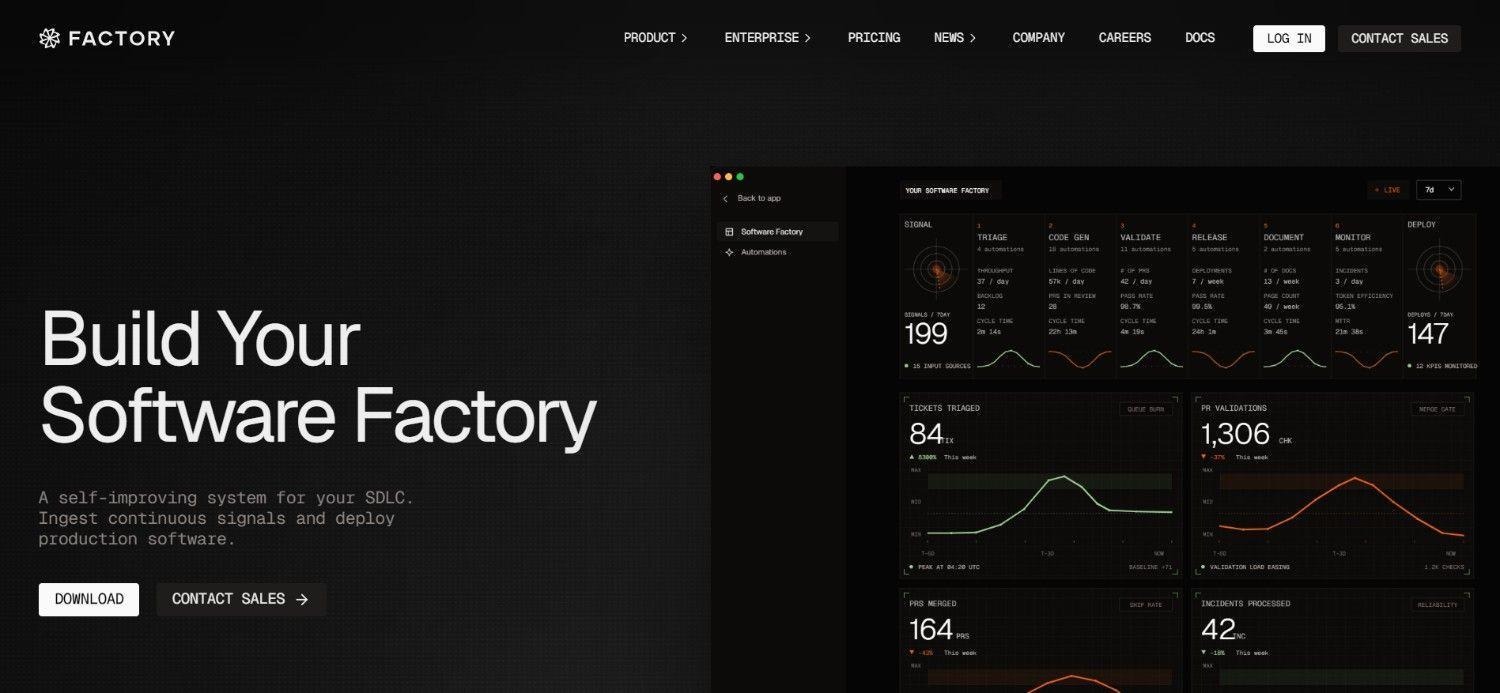
Factory is an AI software development platform that positions itself as an agent-native alternative to traditional software delivery. It deploys AI workers called “Droids” that integrate directly into CI/CD pipelines, pull request workflows, and project management tools to handle software tasks autonomously.
As one of the Blitzy AI competitors with the deepest CI/CD integration, Factory differentiates itself from Blitzy’s batch execution model by operating continuously within existing engineering workflows rather than as a separate large-scale generation platform.
The platform is ideal for engineering teams that want AI embedded in their day-to-day application delivery process.
Ideal For
- Engineering teams that want AI workers integrated directly into their existing CI/CD, PR review, and project management workflows
- Organizations evaluating Blitzy competitors that want continuous autonomous delivery rather than large-batch generation runs
- Teams using GitHub, GitLab, Linear, or Jira who want AI to handle pull request reviews, bug fixes, and routine feature work natively
- Engineering leaders who want AI that participates in the existing engineering process rather than replacing it with a separate platform
- Mid-market software companies that want to reduce engineering overhead on routine tasks without a large-enterprise contract minimum
Top Features
- CI/CD-Native Droids: Factory’s AI workers (Droids) integrate directly into existing CI/CD pipelines, pull request workflows, and project management tools. They handle tasks within the developer’s existing environment rather than requiring a separate platform.
- Autonomous Pull Request Handling: Factory can autonomously handle PR reviews, identify issues, suggest fixes, and implement routine changes within the GitHub or GitLab workflow.
- Asynchronous Task Execution: Factory runs tasks in the background, allowing engineers to review completed work rather than monitoring an active coding session.
Why It’s a Strong Blitzy Alternative
Factory is amongst the more practical Blitzy AI competitors for teams seeking continuous AI-driven delivery integrated into their existing workflow rather than large-batch generation.
While Blitzy requires a separate platform and enterprise contract, Factory works within GitHub, GitLab, Jira, and Linear without requiring workflow changes – at a dramatically lower price point.
Pros
- CI/CD-native integration means no workflow change; Droids work within existing GitHub, GitLab, and Jira setups
- Continuous autonomous delivery rather than large-batch generation runs
- Dramatically more accessible pricing than Blitzy; Pro plan at $20/month
Cons
- Autonomous execution model without expert supervision gates; same enterprise risk friction as other autonomous agents
- Less deep codebase context than Blitzy’s full ingestion model; better suited for well-structured codebases
- Not optimized for large-batch legacy modernization at the scale Blitzy targets
Pricing
Factory’s subscription pricing is Pro at $20/month, Plus at $100/month, Max at $200/month, with team and enterprise pricing plans based on custom requirements.
Final Verdict
Factory is a strong Blitzy alternative for engineering teams that want continuous CI/CD-integrated autonomous delivery at accessible pricing.
It is not suited for large-batch legacy modernization, regulated environments requiring expert supervision gates, or organizations that need Blitzy’s scale of parallel agent execution.
4. Greptile
Overview
Greptile is an AI developer tool that indexes codebases and makes them queryable through natural language, with capabilities extending to AI-powered pull request reviews and a developer chat interface for codebase Q&A.
As one of the more focused Blitzy competitors, Greptile does not attempt to replace the development function. It augments developers and reviewers by giving them AI access to codebase context: ask questions about the system, get grounded answers – followed by submitting a PR, and getting an automated review with context awareness.
Founded in 2023 and backed by Y Combinator, Greptile targets engineering teams that want faster codebase comprehension and automated code review without a large platform commitment.
Ideal For
- Engineering teams that want AI-powered codebase Q&A and PR review capability at low cost, without a full autonomous delivery platform
- Organizations evaluating Blitzy competitors that primarily need better codebase comprehension rather than autonomous code generation
- Development teams onboarding new engineers who need to get up to speed on a complex codebase faster
- Engineering leads who want automated PR reviews with codebase context awareness to reduce manual review burden
- Startups and mid-market companies that want accessible AI codebase tooling without enterprise contract minimums
Top Features
- Codebase Q&A: Natural language questions about the codebase, answered with grounding in actual code across the entire repository, reducing time spent navigating unfamiliar systems.
- Automated PR Reviews: Greptile reviews pull requests with codebase context awareness, identifying potential issues, inconsistencies with existing patterns, and improvement suggestions automatically.
- GitHub Integration: Native GitHub integration means PR reviews are triggered automatically without requiring workflow changes.
Why It’s a Strong Blitzy Alternative
Greptile is one of the most accessible Blitzy AI competitors for engineering teams that need AI-powered codebase understanding and automated review versus full autonomous delivery.
Its free tier with 50 credits per month allows teams to evaluate the tool without any spend, which is a significant contrast to Blitzy’s $50K minimum evaluation cost.
Pros
- Free tier with 50 credits per month allows evaluation without any spend, unlike Blitzy’s minimum evaluation commitment
- Fast onboarding with GitHub integration; no platform migration or workflow change required
- Strong codebase Q&A capability reduces time-to-understanding for new team members and for complex refactoring decisions
Cons
- Not a full development delivery service; covers codebase Q&A and PR review rather than feature development, modernization, or maintenance
- No lifecycle governance, expert supervision, or per-change audit trails
- Limited in scope compared to Blitzy’s autonomous batch generation for large modernization projects
Pricing
Greptile’s pricing is Starter (Free with 50 credits/month), Pro at $30 per seat per month (includes 50 credits, $1 per additional credit), and Enterprise with custom pricing, plus discounts for open-source projects and early-stage startups.
Final Verdict
Greptile is a practical Blitzy alternative for teams that primarily need AI-powered codebase comprehension and automated PR review rather than autonomous code generation.
It is not suited for organizations that need the full delivery scope that Blitzy targets.
5. Augment Code
Overview
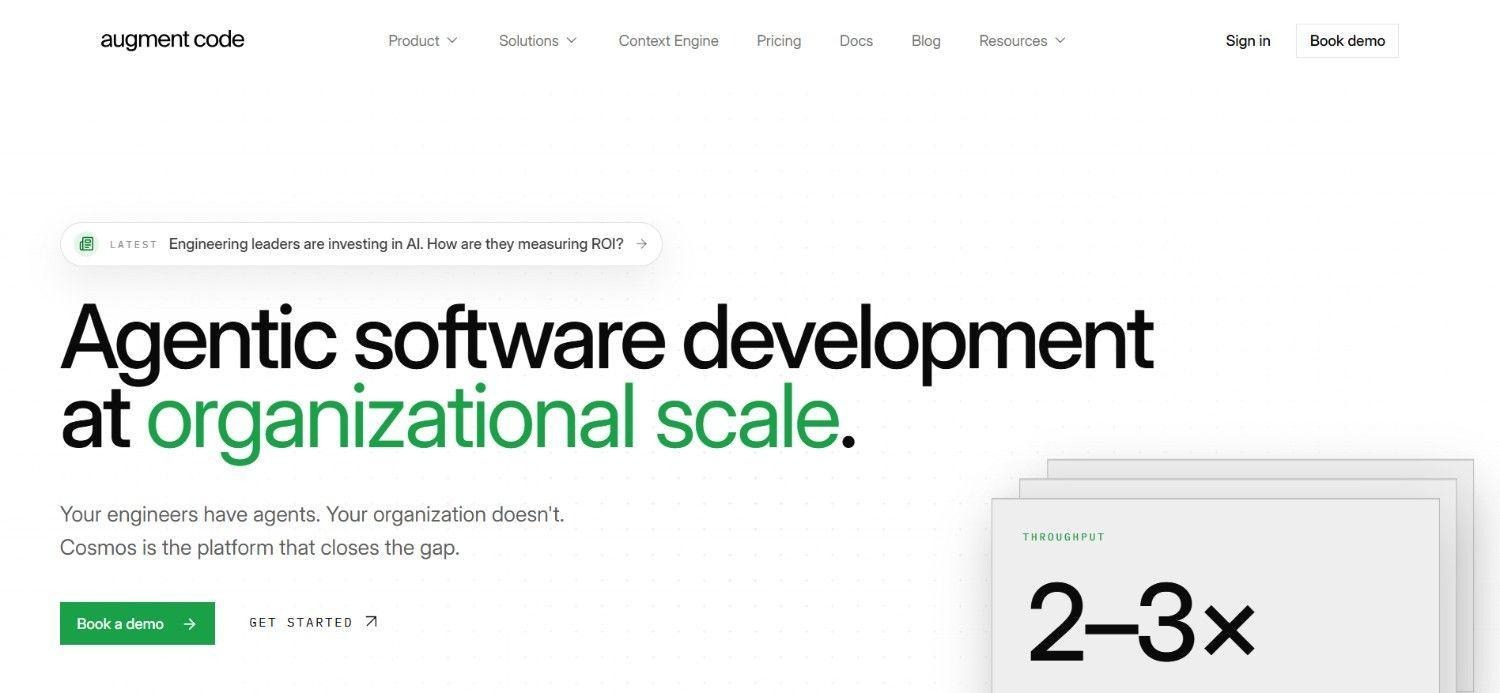
Augment Code is an enterprise-focused AI coding assistant that differentiates itself from other Blitzy AI alternatives through its remote context engine: a system that indexes the entire codebase and connected repositories to provide context-aware suggestions at organizational depth.
Amongst more mature Blitzy AI competitors in enterprise, Augment Code holds SOC 2 Type II certification, offers IP protection policies, and provides enterprise admin controls.
That compliance posture addresses a specific procurement requirement that Blitzy also covers, making it a relevant comparison for enterprises evaluating a coding assistant with enterprise security versus Blitzy’s autonomous platform.
Ideal For
- Enterprise engineering teams that need AI coding assistance with SOC 2 Type II compliance, data residency controls, and IP protection policies built into the product
- Organizations evaluating Blitzy AI competitors where enterprise security procurement requirements are the primary driver
- Large engineering teams where the primary constraint is understanding how components across a distributed codebase interact
- CTOs and security-focused engineering leaders who need a coding assistant that passes enterprise security review without Blitzy’s contract minimum
- Teams that want codebase-wide context depth for in-editor suggestions without a full autonomous delivery platform
Top Features
- Remote Context Engine: Indexes the entire codebase and connected repositories remotely, building a persistent organizational knowledge graph that grounds suggestions in system-wide dependencies and conventions.
- Enterprise Security Posture: SOC 2 Type II certification, IP scanning, data residency controls, and enterprise admin tooling built into the product.
- Agentic Workflows: Multi-step task execution grounded in organizational-level codebase context, rather than session-bound context.
Why It’s a Strong Blitzy Alternative
Augment Code is one of the stronger Blitzy AI competitors for enterprise teams seeking codebase-wide context depth and formal compliance posture without Blitzy’s high pricing.
While Blitzy’s Enterprise tier starts at $500K per year, Augment Code’s Business plan covers up to 50 seats at $100/month – giving teams a better entry point to enterprise-grade AI coding assistance.
Pros
- Remote context engine provides deep codebase understanding at organizational scale without Blitzy’s minimum contract
- SOC 2 Type II certification and built-in IP protection policies address enterprise security procurement requirements
- $100/month for up to 50 seats is dramatically more accessible than Blitzy’s $500K+ minimum
Cons
- A coding assistant, not a full delivery service; covers in-editor suggestions and agentic workflows rather than full lifecycle delivery
- No per-change traceability, expert supervision gates, or lifecycle governance
- Premium pricing relative to individual coding tools; $100/month for 50 seats before additional usage costs
Pricing
Augment Code offers a flat $100/month Business plan for up to 50 seats with $100 of usage included, plus optional top-ups billed at provider API rates with a 40% service fee.
An Enterprise plan is available for organizations at scale.
Final Verdict
Augment Code is a credible Blitzy alternative for enterprise teams that need codebase-wide AI coding assistance with enterprise compliance posture.
It is not suitable for organizations that need Blitzy’s autonomous batch generation, full lifecycle delivery, or the scale of parallel agent execution.
6. GitHub Copilot
Overview
GitHub Copilot is the most widely deployed AI coding assistant in the category, with over 15 million developers and 77,000 organizations as of 2024.
As a Blitzy competitor, Copilot represents a fundamentally different layer of the stack, acting as an IDE extension and GitHub workflow tool that provides in-editor suggestions, PR review assistance alongside “plan-then-build” agent capabilities through the Copilot Workspace.
The comparison is relevant for organizations evaluating AI development investments across the spectrum, from individual developer productivity to full autonomous delivery.
Ideal For
- Engineering teams embedded in the GitHub ecosystem who want AI woven into their PR, Issue, and Actions workflow
- Organizations evaluating Blitzy competitors at an individual developer productivity level rather than a full autonomous platform
- Enterprises that need AI coding tooling with mature compliance posture, SOC 2 certification, and established procurement pathways
- Teams that want Copilot Workspace for plan-then-build agent capability within the GitHub PR workflow
- Organizations that want developer adoption without a large enterprise contract commitment
Top Features
- GitHub-Native Workflow Integration: AI embedded across Pull Requests, Issues, Actions, and the GitHub web editor, providing context at every stage of the development workflow.
- Copilot Workspace: Plan-then-build agent mode that lets developers describe a task, see a proposed implementation plan, and execute across multiple files within the GitHub interface.
- Multi-Model Support: Supports Claude Sonnet, GPT-4.1, GPT-5 mini, and other frontier models. Not locked to a single provider.
Why It’s a Strong Blitzy Alternative
GitHub Copilot is among the more practical Blitzy AI competitors for organizations at an earlier stage of AI development adoption, seeking broad developer productivity improvements before committing to a fully-autonomous delivery platform.
Its familiar GitHub integration reduces adoption friction, and its pricing is dramatically more accessible than Blitzy’s minimum.
Pros
- Dramatically more accessible than Blitzy; starts at $10/user/month vs. $500K+ per year minimum
- Native GitHub integration spans PRs, Issues, Actions, and the web editor, providing broad workflow coverage
- Mature enterprise compliance posture with SOC 2 certification and established procurement pathways
Cons
- Individual developer productivity tool, not a full autonomous delivery platform; cannot replace Blitzy for large-batch legacy modernization
- Credit-based billing since mid-2025 creates cost unpredictability for heavy users
- No lifecycle governance, per-change traceability, or expert supervision at the organizational level
Pricing
GitHub Copilot starts at $10/month for individuals, going up to $100/month at the Max tier. Enterprise plans start at $19/user/month and $39/user/month, with usage-based AI credits billing introduced from June 2026 onwards.
Final Verdict
GitHub Copilot is a practical Blitzy alternative for organizations seeking broad developer productivity improvement at accessible pricing.
It is not a substitute for Blitzy’s autonomous batch generation, large-scale legacy modernization, or full lifecycle delivery – but it provides a lower-risk entry point to AI-assisted software development.
7. Claude Code
Overview
Claude Code is Anthropic’s terminal-based agentic coding tool, built on Claude’s long-context reasoning capability and available as a CLI.
As a Blitzy competitor, Claude Code operates at the individual developer level, with a single developer running agentic coding tasks in their terminal, followed by reviewing and applying diffs at each step. That model is fundamentally different from Blitzy’s “thousands-of-agents” parallel execution for enterprise batch modernization.
This comparison is most useful for individual developers, small teams, and organizations deciding whether developer tools are enough before investing in a autonomous AI platform.
Ideal For
- Experienced developers who want strong agentic coding capability in a terminal-first workflow, with the developer actively in the execution loop
- Teams evaluating Blitzy AI competitors at the individual developer level before committing to an enterprise platform
- Engineering teams that need multi-file refactoring and codebase-level reasoning on large, complex codebases without a large platform commitment
- Developers already on Anthropic subscriptions who want to consolidate tooling costs
- Organizations where the primary bottleneck is individual developer speed rather than organizational delivery governance
Top Features
- Long-Context Codebase Reasoning: Maintains context across large portions of a codebase in a single session, producing multi-file edits with strong cross-system awareness.
- Developer-In-The-Loop Execution: Produces diffs for developer review rather than generating large code batches autonomously, keeping humans in the execution process at each step.
- MCP and Tool Integration: Native MCP support connects Claude Code to external tools, databases, and services, extending context beyond the local filesystem.
Why It’s a Strong Blitzy Alternative
Claude Code is one of the stronger Blitzy competitors for individual developers who want advanced agentic coding without an enterprise platform.
Its long-context model handles large codebases well, while its developer-in-the-loop approach reduces governance concerns associated with autonomous execution.
Pros
- Long-context reasoning handles large and complex codebases more effectively than most IDE tools
- Developer-in-the-loop model keeps humans in the execution process, avoiding the autonomous risk concerns of Blitzy’s approach
- Dramatically more accessible than Blitzy; Pro plan at $20/month vs. $500K+ minimum
Cons
- Terminal-only; no IDE integration; requires workflow change for editor-first developers
- No lifecycle governance, per-change traceability, or expert supervision; cannot substitute for Blitzy’s organizational-level delivery
- API token consumption can compound on large tasks; similar cost management challenge as Blitzy’s per-line pricing at scale
Pricing
Claude Code pricing: Free tier, Pro at $20/month (or $200/year), Max at $100 or $200/month for 5x or 20x Pro usage, Team at $25 to $30/user/month, and Enterprise at custom pricing.
Final Verdict
Claude Code is a strong Blitzy alternative for individual developers and small teams who want agentic codebase reasoning at accessible pricing. It cannot replicate Blitzy’s scale, its thousands-of-agents parallel execution, or its organizational delivery governance.
For developers who need Blitzy-level codebase depth without Blitzy’s price, Claude Code is worth evaluating.
8. Amazon Q Developer
Overview
Amazon Q Developer is AWS’s AI coding assistant for VS Code, JetBrains, and the AWS Management Console. It stands out by combining application and AWS infrastructure context, making it a strong choice for AWS-native teams.
Its automated Java upgrade tool also supports legacy modernization, making it a relevant Blitzy competitor for organizations focused on Java modernization rather than broad enterprise-scale transformation.
Ideal For
- Engineering teams building primarily on AWS who want AI coding assistance that understands both application code and cloud infrastructure context
- Organizations evaluating Blitzy AI competitors for AWS-native Java modernization use cases at a dramatically lower price point
- Teams that want built-in security scanning integrated into the coding workflow without a separate SAST tool
- AWS-native mid-market companies that want cloud-infrastructure-aware AI assistance without an enterprise platform commitment
- Engineering managers who want AI coding assistance that integrates into the existing IDE without a separate platform deployment
Top Features
- AWS-Native Codebase Context: Simultaneously pulls context from AWS service documentation, account infrastructure, and application code, producing more relevant suggestions for AWS-native teams.
- Built-In Security Scanning: Code vulnerability scanning integrated into the coding workflow at point of generation, reducing the need for separate SAST tooling.
- Automated Java Upgrade: AI-guided transformation capability that automates Java framework upgrades, addressing a specific modernization use case that overlaps with Blitzy’s capabilities at a much lower price point.
Why It’s a Strong Blitzy Alternative
Amazon Q Developer is one of the more relevant Blitzy alternatives for AWS-native teams focused on Java modernization. Its automated Java upgrade capabilities overlap with one of Blitzy’s core use cases at a much lower cost.
The tool also delivers infrastructure-aware coding suggestions by combining AWS and application context, making it more effective than generic coding assistants for AWS environments.
Pros
- AWS-native context and automated Java upgrade capability address a specific Blitzy use case at dramatically lower cost
- Built-in security scanning reduces the need for separate SAST tooling
- Free tier for individuals; Pro at $19/user/month is significantly more accessible than Blitzy’s minimum
Cons
- Not suited for the large-batch legacy modernization at scale that Blitzy targets; covers individual developer productivity
- Value diminishes significantly outside the AWS ecosystem
- No lifecycle governance, per-change traceability, or expert supervision
Pricing
Amazon Q Developer has a perpetual Free tier with monthly limits and a Pro plan at $19/user/month with higher usage limits and advanced features.
Usage also consumes AWS credits and tokens priced per token depending on the selected model.
Final Verdict
Amazon Q Developer is a strong Blitzy alternative for AWS-native teams that need infrastructure-aware coding assistance and built-in security scanning.
While it cannot match Blitzy’s large-scale parallel execution, it offers meaningful Java modernization capabilities at a much lower cost.
9. OpenAI Codex
Overview
OpenAI Codex is OpenAI’s cloud-based agentic coding system, available through ChatGPT. It can read repositories, write code, run tests, and handle multi-step development tasks in a cloud sandbox, with multiple tasks running in parallel.
Compared with Blitzy, Codex is a better fit for organizations already using the OpenAI ecosystem that want agentic coding without investing in a separate enterprise platform.
It works especially well for greenfield projects and well-structured codebases where deep legacy system understanding is not the primary requirement.
Ideal For
- Teams already paying for ChatGPT Plus or Pro who want agentic coding capability without a separate subscription or platform commitment
- Organizations evaluating Blitzy competitors within the OpenAI ecosystem at zero additional cost for existing subscribers
- Greenfield developers and prototypers who want natural language to code capability at scale within the ChatGPT interface
- Engineering managers who want to submit well-scoped tasks and review output in batches without monitoring an active agent session
- Teams exploring AI-assisted development before committing to an enterprise platform like Blitzy
Top Features
- Asynchronous Cloud Execution: Codex runs tasks in a cloud sandbox with multiple tasks running concurrently across repositories or features.
- ChatGPT Integration: Accessible directly through ChatGPT; no additional tool management for teams already using ChatGPT.
- Multi-Task Parallelism: Multiple Codex tasks can run concurrently, useful for teams managing several features or bugs simultaneously.
Why It’s a Strong Blitzy Alternative
OpenAI Codex is one of the most accessible Blitzy alternatives for teams already using ChatGPT. It offers asynchronous agentic coding with no additional platform purchase.
While its parallel task execution resembles Blitzy’s approach, it operates at a much smaller scale.
Pros
- Bundled into existing ChatGPT subscriptions; zero additional cost for existing users
- Asynchronous execution allows task parallelization within the ChatGPT interface
- Strong greenfield prototyping capability for well-structured codebase tasks
Cons
- No IDE integration; browser and API-based only, creating friction for most developer workflows
- Cannot approach Blitzy’s scale, codebase ingestion depth, or legacy modernization capability
- Not suited for the regulated enterprise brownfield modernization that Blitzy targets
Pricing
OpenAI Codex is bundled into ChatGPT plans: Free ($0), Go ($8/month), Plus ($20/month), and Pro ($100/month) for individuals.
Teams and businesses start at $20/user/month, with Enterprise at custom pricing.
Final Verdict
OpenAI Codex is the most cost-accessible Blitzy alternative for existing ChatGPT users who want agentic coding without any additional spend.
It cannot replicate Blitzy’s enterprise legacy modernization capabilities, but provides a zero-cost entry point for organizations exploring AI development before committing to an enterprise platform.
10. Gemini Code Assist
Overview
Gemini Code Assist is Google’s enterprise AI coding assistant, built on the Gemini model family. Its standout feature is a 1 million token context window, allowing it to understand large codebases more effectively than most coding assistants.
This makes it a strong option for Google Cloud teams working on large monorepos or complex architectures.
Unlike Blitzy, however, it focuses on individual developer productivity rather than organization-wide, batch AI execution.
Ideal For
- Engineering teams building on Google Cloud who want AI coding assistance that spans both application code and cloud infrastructure context
- Organizations evaluating Blitzy AI competitors for large codebase reasoning capability without an enterprise platform commitment
- Enterprises with very large codebases where other coding tools hit context window limits that create incomplete suggestions
- Google Workspace organizations that want AI coding assistance integrated into their existing Google tooling
- Teams that want a 30-day free trial for up to 50 users before committing
Top Features
- 1 Million Token Context Window: Indexes and reasons over significantly larger codebases than most alternatives, materially improving suggestion quality for teams with large monorepos.
- Google Cloud Integration: Direct context from Google Cloud infrastructure alongside application code produces infrastructure-aware suggestions for Google Cloud-native teams.
- Enterprise Security Controls: Data residency options, VPC Service Controls, and Google’s enterprise compliance posture address enterprise procurement requirements.
Why It’s a Strong Blitzy Alternative
Gemini Code Assist is a strong Blitzy competitor for teams primarily seeking deeper codebase context. Its 1 million token context window supports large-scale code understanding at a much lower cost.
However, it delivers this through an AI coding assistant rather than Blitzy’s autonomous batch execution model.
Pros
- 1 million token context window is the largest in the coding assistant category; addresses large codebase context needs at accessible pricing
- Google Cloud integration produces infrastructure-aware suggestions for teams in the Google ecosystem
- 30-day free trial for up to 50 users provides a genuine enterprise evaluation window
Cons
- Coding assistant, not an autonomous delivery platform; cannot replicate Blitzy’s batch generation or organizational-level delivery
- Value diminishes significantly outside the Google Cloud and Workspace ecosystem
- No lifecycle governance, per-change traceability, or expert supervision
Pricing
Gemini Code Assist is priced at $22.80/user/month (Standard monthly) or $19/user/month (Standard annual), and $54/user/month (Enterprise monthly) or $45/user/month (Enterprise annual), with a 30-day free trial for up to 50 users.
Final Verdict
Gemini Code Assist is a practical Blitzy alternative for Google Cloud teams that need deep codebase context at a lower cost.
While it cannot match Blitzy’s large-scale autonomous execution, its 1 million token context window makes it one of the strongest AI coding assistants for large codebases.
Why Does CloudGeometry Work Across Multiple Use Cases?
The tools above represent the full spectrum of Blitzy competitors, from free developer tools to enterprise coding assistants. Where they stop, AI-MSL picks up.
The use cases below show where the difference is most material, with real engagement outcomes behind each one:
1. CloudGeometry for Mid-Market Organizations Priced Out of Blitzy
One of the main reasons organizations evaluate CloudGeometry as a Blitzy alternative is cost.
Blitzy’s Enterprise tier starts at $500K per year with a 36-month commitment, while AI-MSL is designed for mid-market organizations with annual development budgets of $500K or more and pricing based on approved scope.
Structurally, the two are very similar. Both build a persistent semantic model of the customer’s codebase, support existing production systems, and handle legacy modernization alongside new feature development.
Their biggest differences are delivery model and accessibility. For B2B SaaS specifically — our current launch vertical — FaceUp and TetraScience are available as reference customers.
2. CloudGeometry for Regulated Environments
Blitzy’s SOC 2 Type II and ISO 27001 certifications help meet enterprise security requirements. However, organizations operating under external audit obligations often require per-change traceability and documented expert review, not just platform certifications.
AI-MSL addresses this by generating a complete traceability chain for every deployed change, including business requirements, technical specifications, architecture decisions, review records, and deployment history.
The documentation is created during delivery, not afterward.
One of our customers, Nanox passed a HIPAA audit without findings after adopting AI-MSL, with audit-trail traceability built into every change as part of the flow, not assembled retroactively.
3. CloudGeometry for Continuous Lifecycle Delivery
Blitzy is designed for large, one-time transformation projects.
Most mid-market SaaS and technology companies need something different: a governed pipeline that continuously delivers new features, bug fixes, maintenance, and modernization. AI-MSL is built for that model.
Digital Remedy ran that model across three products at once, reaching roughly 5x development velocity at approximately 10% of in-house cost, with sprint-level tasks that previously took multi-week cycles completing in days.
4. CloudGeometry for Engineering Cost Reduction
Blitzy charges $0.20 per line of generated code, so costs can rise quickly on large projects.
AI-MSL uses outcome-based Dev Credits tied to approved changes, at roughly one-third the cost of traditional consulting. You pay for delivered outcomes, not code volume.
Nanox reduced its engineering team from 12 to 2 engineers plus one QA manager, while Digital Remedy achieved roughly 5x development velocity at approximately 10% of the cost of an equivalent in-house engineering team.
5. CloudGeometry for Knowledge Retention Through Attrition
Codebase ingestion answers what the system looks like. It does not answer why the system is shaped that way, because that reasoning was never committed to the repository — it lives in the heads of two or three long-tenured engineers. When one of them leaves, modernization stops regardless of how many lines a platform can read.
AppGraph captures that tribal knowledge through supervised scanning during the initial assessment, then keeps it current as the system evolves. Longroad Energy’s evaluation phase converted undocumented knowledge of a live production BI pipeline into reusable context bundles that now ground every future change request, against roughly 6,000 monitored devices and 2.5 GB of daily telemetry.
6. CloudGeometry for AI Capability Integration
Blitzy builds and modernizes existing software systems. What it does not address is organizations that want to ship AI agents, copilots, or intelligent automation as new product capabilities inside their existing products.
Our enterprise agentic AI platform, LangBuilder, serves exactly that use case. Eventric delivered a working AI-powered venue comparison engine proof of concept in roughly 6 weeks using LangBuilder.
For organizations that want to ship AI product capabilities, not just modernize existing code, AI-MSL covers that alongside standard lifecycle delivery.
When Does It Make Sense to Change Delivery Models?
Most organizations do not move off an enterprise AI delivery platform because they read a comparison article. They move because something changed, or because a commitment is coming up for renewal. If one of the following applies, the evaluation is probably worth running now rather than at the next contract cycle.
A renewal is approaching. Multi-year terms concentrate the decision into a single window. The months before renewal are when alternatives are worth pricing seriously, not the months after signing.
A new cost mandate landed. A CFO or board has asked for a specific reduction in software development spend, and volume-based pricing makes the forecast hard to commit to.
The work shifted from transformation to steady state. Batch execution suits a defined modernization project. Once that project ships and the need becomes continuous features, fixes, and maintenance, the delivery model that got you there is not necessarily the one that keeps you there.
A senior engineer resigned. The reasoning behind key architectural decisions usually lives in two or three people rather than in the repository. If losing one of them would materially damage your ability to change your own product, the system intelligence problem is already active.
An audit finding requires stronger delivery governance. Someone has asked you to trace a deployed change back to a business requirement, through a named reviewer, and you could not do it quickly.
Roadmap commitments keep slipping. If product leadership is repeatedly re-forecasting delivery dates against the same engineering capacity, the bottleneck has moved from prioritization to execution.
Organizations arriving with one of these triggers typically move through evaluation in 3 to 4 weeks rather than the usual 10 to 12, because the problem is already defined internally.
What Makes a Good Blitzy Alternative?
Not every Blitzy competitor solves the same problem. The right criteria depend on why you are looking for an alternative. Here are the six that matter most.
1. Accessibility at Mid-Market Scale
The most common reason organizations evaluate Blitzy alternatives is the price floor.
A minimum of $500K per year excludes most mid-market technology companies regardless of technical fit.
A genuine Blitzy alternative needs to be accessible to companies with $500K or more in annual development budget, not just Global 2000 enterprises with eight-figure software investments.
2. Delivery Model: Batch vs. Continuous
Blitzy is a batch execution platform: ingest the codebase, run thousands of agents for days, deliver a large output, review. That model suits defined transformation projects.
Organizations that need continuous delivery, features and bug fixes and maintenance and modernization flowing through a single pipeline every sprint, need a different model.
Evaluate Blitzy alternatives on whether they support continuous delivery or only batch execution.
3. Governance and Traceability
Blitzy provides QA agents that review each other’s output before code reaches the customer, and it is SOC 2 Type II and ISO 27001 certified.
What it does not provide is per-change expert review gates or per-change audit trails from business requirement to deployment record. For organizations in regulated environments, that gap matters.
Evaluate whether an alternative produces per-change traceability as a natural output, not just platform-level security certification.
4. Does the System Model Persist, and Who Owns It?
Deep codebase ingestion is Blitzy’s strongest capability, and on raw scale nothing else on this list matches it.
The question worth asking is what happens to that understanding afterward. A model built for a defined transformation project serves that project. A model that updates continuously as your system evolves, and that you can export and keep, is a different kind of asset — it survives the engagement, and it survives the departure of the engineers who held the same knowledge in their heads.
Ask any vendor what persists when the contract closes. AppGraph exists specifically so the answer is “a structured model of your system that you own and export.” Against a multi-year commitment, that is the question with the longest tail.
5. Where Does Your Code Live, and What Does Exit Look Like?
For organizations with a CISO in the buying process, two questions decide the review: does code leave your environment, and what happens if you stop.
CloudGeometry operates on your existing infrastructure. The default is an isolated managed-cloud tenant; VPC, on-premises, and air-gapped deployment are available where code must never leave your own deployment plane. Client code is never used to train any underlying model, and every lifecycle artifact — including the AppGraph itself — is your IP and exportable in standard formats. If the relationship ends, nothing has to be migrated back.
The longer the contract term under evaluation, the more this question is worth answering before signing rather than after.
6. Contract Flexibility
Blitzy’s minimum evaluation phase costs $50K for two months. Its Enterprise tier requires a 36-month commitment. For organizations that need to prove ROI before any large commitment, contract flexibility matters.
Evaluate whether alternatives allow shorter evaluation periods, lower minimum commitments, and outcome-based pricing before multi-year terms.
How to Choose the Right Blitzy Alternative for Your Needs?
The criteria above define what to look for. These five steps show how to apply them:
1. Identify Why You Are Evaluating Blitzy Alternatives
Start by naming the specific reason:
- Is Blitzy’s price floor inaccessible?
- Is the batch execution model not suited to your continuous delivery needs?
- Do you need per-change expert supervision that Blitzy does not provide?
- Are you looking for a lower-commitment evaluation path?
Each of these points to a different category of alternative.
2. Assess Whether You Need Batch or Continuous Delivery
If your primary use case is a large, defined modernization project with a clear start and end, batch execution tools like Devin AI or Factory are worth evaluating, and Blitzy itself remains the strongest option at that scale if the commitment is workable for you.
If your primary use case is continuous delivery across the full engineering lifecycle, a managed delivery service like CloudGeometry is the more appropriate category.
3. Define Your Budget and Commitment Tolerance
Blitzy’s minimum is $500K per year on a 36-month term. If that is accessible, Blitzy itself may be the right choice for large-scale legacy modernization.
If it is not, define your actual budget and commitment tolerance before evaluating alternatives.
The tools on this list range from $0 for existing ChatGPT users to $500K+ for mid-market managed delivery, with very different delivery models at each price point.
4. Evaluate Governance Requirements Early
If your organization has a CISO, compliance team, or board-level scrutiny on AI adoption, bring governance requirements into the evaluation before testing tools.
Determine whether you need per-change audit trails, expert supervision gates, or formal compliance certification.
Blitzy covers certification; it does not cover per-change expert review gates. Most Blitzy competitors on this list cover neither.
The operating principle is simple enough to put on one line: AI executes. Humans govern. Context grounds the work. Every option here does the first part. The question is who does the other two, and whether that person has a name.
5. Test on Real Production Code, Not Demos
Every tool on this list performs better on greenfield demos than on real brownfield production systems.
Before committing to any Blitzy alternative, test on a representative sample of your actual production codebase.
The performance gap between a vendor demo and a real legacy system with 20 years of decisions baked into it is significant for most AI development tools.
Everything You Need to Know About Blitzy Competitors
Ready to Move On from Blitzy? Try CloudGeometry
Blitzy is a strong choice for Global 2000 enterprises running large-scale legacy modernization programs.
Alternatively, for mid-market organizations – AI-MSL delivers governed AI lifecycle execution at a more accessible price. The AppGraph intelligence layer provides persistent system intelligence, and expert supervision at three defined gates produces per-change traceability as an output of the work rather than a separate documentation effort.
Our outcome-based pricing ties costs to approved tasks, not code volume. AI-MSL is built for organizations with brownfield production systems & annual development budgets above $500K.
The first step is a System Intelligence Assessment: fixed price, time-boxed, delivered in days. You get an AppGraph of your system and a structured health report, and you keep both regardless of what you decide next — which is a materially different commitment from a multi-year enterprise term.
- Book a discovery call — we can also arrange a reference call with the VP of R&D at Nanox (Nasdaq: NNOX) on how the operating-model transition actually went
- Model your numbers with the AI-MSL savings calculator
- Read the whitepaper: From AI-Assisted Coding to AI-Governed Software Lifecycle
FAQs About Blitzy Competitors
What is Blitzy used for?
Blitzy is an enterprise AI software development platform built for large-scale legacy modernization, migrations, and greenfield projects. It uses thousands of parallel AI agents to generate and test production-ready code. As of 2026, Blitzy has raised $200 million at a $1.4 billion valuation, counts State Street among its customers, and starts at $500K per year on a 36-month Enterprise commitment.
What are the best Blitzy competitors in 2026?
CloudGeometry is the best Blitzy alternative because it replaces autonomous batch execution with expert-supervised continuous delivery. Where Blitzy deploys thousands of agents to generate large code batches, AI-MSL runs every change through three human approval gates, grounds AI in AppGraph’s persistent system context, and prices on approved outcomes. The result is governed lifecycle delivery accessible to mid-market organizations, not just Global 2000 enterprises.
What features should I look for in a Blitzy alternative?
The right Blitzy alternative depends on the problem you’re solving. For lower costs, look for mid-market pricing. For continuous delivery, choose lifecycle-focused services over batch execution. For regulated environments, prioritize expert supervision and per-change traceability. For brownfield systems, look for persistent system intelligence instead of session-based context.
How to choose the best Blitzy alternative for your needs?
Choose a Blitzy alternative by first identifying why you’re looking for one, whether it’s pricing, delivery model, governance, or contract flexibility. Then decide if you need large-scale transformation or continuous delivery, factor in compliance requirements, and evaluate each option on your own production code instead of vendor demos.
Is it easy to switch from Blitzy to an alternative?
Switching from Blitzy to a coding assistant or IDE tool usually takes less than an hour. Moving to CloudGeometry starts with a System Intelligence Assessment that builds an AppGraph of your existing system. The key priority is preserving or rebuilding codebase context, especially for brownfield production systems where reliable AI execution depends on deep system understanding.
Is CloudGeometry better than Blitzy?
CloudGeometry and Blitzy serve different markets. Blitzy focuses on Global 2000 enterprises running large-scale autonomous modernization, while CloudGeometry is built for mid-market technology companies that need continuous, expert-supervised AI delivery. Both build persistent system intelligence, but Blitzy emphasizes batch execution, whereas AI-MSL focuses on governed lifecycle delivery at a more accessible scale.
What is the main difference between CloudGeometry and Blitzy?
CloudGeometry and Blitzy differ mainly in delivery model and target market. Blitzy uses large-scale autonomous batch execution for Global 2000 enterprises. CloudGeometry provides continuous, expert-supervised AI delivery for mid-market companies. Blitzy charges per line of generated code, while CloudGeometry uses outcome-based pricing tied to approved, delivered changes.
Does Blitzy provide expert human supervision at each step?
Blitzy uses AI QA agents to review generated code before delivery, but it does not include human expert approval at each lifecycle stage. CloudGeometry’s AI-MSL adds expert review throughout the process, helping organizations meet the governance and audit requirements common in regulated industries.


