Choosing the right custom software development company can determine whether a project ships on time or stalls for months. The market in 2026 is crowded - traditional consulting firms, AI-native delivery models, nearshore agencies, and talent marketplaces all compete for the same contracts.
This guide compares the 10 best custom software development companies across pricing models, delivery approaches, strengths, and limitations. The goal is to help you match your project to the right partner.
Key Takeaways (TL;DR)
- The Best Overall Custom Software Development Company: CloudGeometry delivers AI-governed software lifecycle execution through its AI-MSL service, combining AI-driven development with expert human supervision to reduce lifecycle costs by roughly one-third and deliver up to 10x faster on equivalent scope compared to traditional models. It is purpose-built for mid-market companies running brownfield production systems that need to ship faster without growing headcount.
- Why Do You Need It: Off-the-shelf software cannot accommodate the specific workflows, integrations, and compliance requirements that mid-market and enterprise organizations face. Custom development closes the gap between what generic tools offer and what your business actually needs to operate, compete, and grow.
- Who It's For: CTOs, VPs of Engineering, and CFOs at companies with 200-2,000 employees, $50M-$2B in revenue, and existing production software systems. Also relevant to product leaders whose roadmaps are blocked by engineering capacity constraints.
- How to Choose the Right One: Evaluate three factors first: delivery model fit (managed service vs. staff augmentation vs. project-based), domain expertise in your vertical, and how the company handles system knowledge transfer and governance. A partner that retains system context as a durable asset will outperform one that treats every engagement as a fresh start.
- Pricing Model: CloudGeometry uses an outcome-based pricing model structured around three components. The System Intelligence Assessment (SIA) is a fixed-price, time-boxed entry point that delivers standalone value - an AppGraph of your system and a structured health report. From there, the Maintenance Subscription covers ongoing corrective, adaptive, and continuous maintenance under AppGraph governance. Dev Credits are drawn against approved development scope for new features, modernization, and AI capabilities, with cost projected and approved before work begins.
Table of Contents
- Top Custom Software Development Companies in 2026 at a Glance
- What Are Custom Software Development Services?
- Why Do You Need Custom Software Development Services?
- Who Needs Custom Software Development Services?
- Best Custom Software Development Services: In-Depth Review & Comparison
- How to Choose the Best Custom Software Development Company (What To Consider)
- Everything You Need to Know About Custom Software Development Services
- Build Smarter with CloudGeometry
- FAQs About Custom Software Development Companies
Top Custom Software Development Companies in 2026 at a Glance
What Are Custom Software Development Services?
Custom software development is the process of designing, building, testing, and maintaining software tailored to a specific organization's workflows, integration requirements, and growth trajectory. Unlike off-the-shelf SaaS products, which are designed for broad markets and require businesses to adapt their processes to the tool, custom-built software adapts to the business.
These services cover a wide range of use cases.
On the build side, companies commission custom applications when no existing product fits their operational model - a claims processing engine with specific regulatory logic, a logistics platform that integrates with proprietary hardware, or a customer-facing portal tied to internal ERP data. On the modernization side, companies hire development partners to migrate legacy monoliths to cloud-native architectures, decompose tightly coupled systems into maintainable services, or add AI capabilities to existing products.
Maintenance is the third major category, and often the least visible. Production systems need bug fixes, security patches, dependency upgrades, and performance tuning. For many mid-market companies, this maintenance work consumes 30-50% of engineering capacity, leaving less room for the feature development and modernization that drive growth.
The delivery models behind these services have evolved considerably. Traditional systems integrators (EPAM, Globant, ThoughtWorks) assign dedicated engineering teams to build and maintain client systems. Talent marketplaces (Toptal, BairesDev) connect companies with vetted individual engineers who work within the client's existing processes.
A newer category, AI-governed managed services like CloudGeometry's AI-MSL, uses supervised AI execution to run the full software development lifecycle at a fraction of traditional cost, with human experts governing every stage. Understanding which model fits your organization is the first and most consequential decision in the selection process.
Why Do You Need Custom Software Development Services?
Most companies do not start looking for a custom development partner because they want to build software. They start looking because something is broken or blocked.
Custom development makes sense when the alternative, adapting your operations to a generic tool, costs more in lost efficiency, missed integrations, or compliance gaps.
Here is where the pressure typically comes from:
- Engineering costs are rising while output stays flat: Hiring senior developers is expensive, slow, and increasingly competitive. Many mid-market companies spend significant portions of their engineering budget on teams whose capacity is consumed by maintenance, leaving little room for new feature development or modernization.
- AI coding tools improved individual speed but not organizational throughput: Tools like GitHub Copilot and Cursor made individual developers faster. But the coordination overhead, tribal knowledge gaps, and review bottlenecks that constrain delivery at the organizational level did not change. The engine got faster while the steering system stayed the same.
- Technical debt compounds: According to multiple industry surveys, development teams spend 25-40% of their time on maintenance and technical debt rather than new features. Without a structured approach to application modernization, that ratio worsens every quarter.
- Compliance requirements demand traceability: In healthcare, financial services, and insurance, every deployed change needs a traceable path from business requirement through production. Generic tools and fragmented workflows make this audit trail expensive to assemble after the fact.
A custom software development partner, whether a traditional firm or an AI-governed managed service, addresses these gaps by taking ownership of delivery execution. That frees the organization to focus on product strategy and business outcomes.
Who Needs Custom Software Development Services?
CTOs and VPs of Engineering
Technology leaders managing engineering teams often spend more time coordinating and maintaining systems than building new features. The maintenance burden consumes capacity that should go toward product development and modernization.
These leaders need a partner that can absorb lifecycle execution - maintenance, modernization, and feature development - while preserving architectural integrity and system knowledge. The right partner reduces the coordination surface rather than adding to it.
CFOs and COOs
Business executives are increasingly accountable for engineering spend as a cost center. When the board asks what the company gets for its annual engineering investment and the answer is unclear, the cost structure becomes a strategic problem.
A managed development partner with outcome-based pricing and traceable delivery changes the conversation. Instead of justifying headcount, leadership can point to approved changes delivered against a predictable cost model.
Product Leaders
VPs of Product and CPOs frequently find their roadmaps blocked by engineering bandwidth. Feature backlogs grow despite continued hiring. The constraint is not coding speed - it is lifecycle throughput.
Custom development services unlock capacity without growing headcount. They allow product teams to accelerate feature delivery and roadmap execution while engineering leadership maintains quality and architectural control.
Mid-Market SaaS Companies
Companies with 200-2,000 employees whose core business is software face a specific challenge. Their engineering teams are stretched thin between maintenance, feature work, and modernization - all competing for the same limited capacity.
For these companies, software lifecycle costs directly impact margins. A development partner that reduces per-change cost while maintaining quality creates a structural advantage that compounds over time.
Enterprises in Regulated Verticals
Organizations in healthcare, financial services, and insurance operate under compliance requirements (HIPAA, PCI-DSS, SOX) that add layers of governance to every change. Every deployment needs documentation, traceability, and evidence required by auditors.
They need development partners who can produce that traceability as part of the delivery process - not as a separate documentation exercise assembled after the fact. Partners with built-in governance models save these organizations significant compliance overhead.
Best Custom Software Development Services: In-Depth Review & Comparison
1. CloudGeometry
Overview
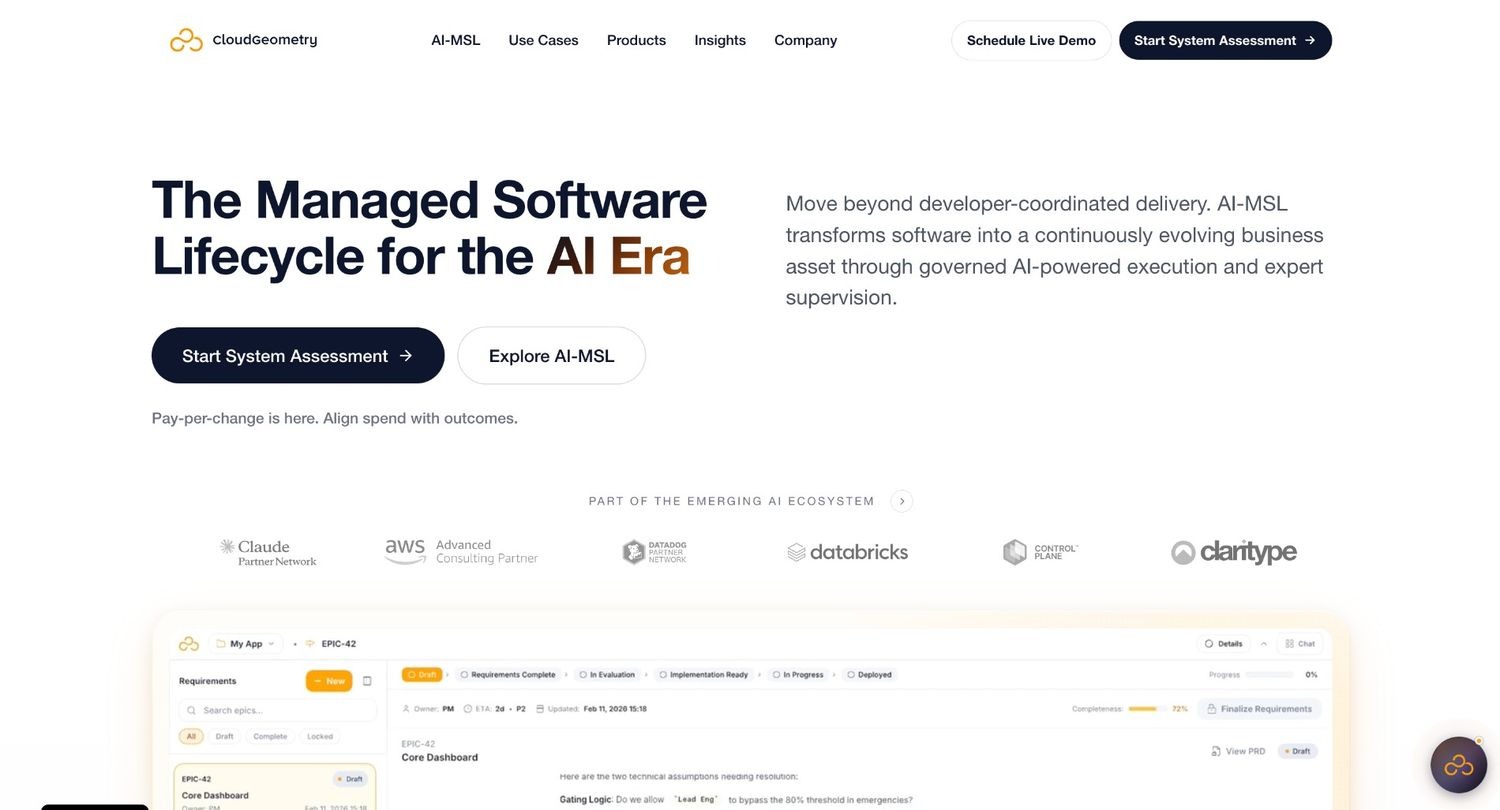
CloudGeometry is an AI transformation partner that delivers AI-MSL (AI Managed Software Lifecycle) - a managed engineering service that runs software development and maintenance using AI, supervised by senior engineering experts, grounded in a semantic system model called AppGraph. Founded in 2014 in Silicon Valley, the company evolved from an AWS consulting and staff augmentation background into a pioneer of the AI-governed software lifecycle category.
CloudGeometry partners with mid-market technology companies (200-2,000 employees, $50M-$2B revenue) to replace or augment retained engineering teams with governed, AI-driven lifecycle execution. The company operates across the full lifecycle: requirements intelligence, AI-powered development, managed DevOps and CloudOps, and ongoing maintenance.
The AI-MSL service is delivered through a four-layer architecture. AppGraph serves as the semantic system intelligence layer - a structured, queryable model of the customer's software system connecting source code, architecture artifacts, APIs, infrastructure, documentation, and operational procedures. Above that, the AI Lifecycle Execution Layer performs structured work across requirements, specifications, code, test, release, and operate stages.
A Supervised Governance Model controls lifecycle progression through three explicit gates: Product Owner (intent), Architect (design), and AI Lifecycle Manager (release readiness). The Client Control Layer keeps the organization connected to all work through the AI-MSL Application (Product Owner Workspace), surfacing lifecycle state, artifacts, gate status, decision history, and production outcomes in one place.
Beyond AI-MSL, CloudGeometry delivers technology solutions including application modernization, cloud-native and Kubernetes adoption, managed data engineering, managed CloudOps (24x7 on AWS, Azure, or Google Cloud), AI transformation (AI readiness, education, and strategy), and professional services and customer success engineering. The company also maintains open-source products: LangBuilder (an agentic workflow platform for enterprise AI operations) and CGDevX (a CNCF Kubernetes Certified platform for scalable enterprise application delivery).
Ideal For
- Mid-market SaaS companies looking to reduce engineering lifecycle costs while maintaining or increasing feature velocity
- CTOs and VPs of Engineering with 15+ person teams spending more time on maintenance than new development
- CFOs evaluating engineering ROI who want outcome-based pricing instead of per-engineer costs
- Companies with brownfield production systems needing incremental modernization without a big-bang rewrite
- Organizations that tried AI coding tools but saw individual productivity gains fail to translate to organizational throughput
Why Do We Stand Out?
CloudGeometry takes a different approach from both traditional development firms and AI coding tools:
- AI-MSL replaces the engineering team, not the product owner: The customer keeps product strategy, business priorities, and roadmap ownership. CloudGeometry owns lifecycle execution - from requirements through production-ready code delivery.
- AppGraph captures system intelligence as a durable asset: Rather than relying on tribal knowledge locked in specific engineers' heads, AppGraph is a semantic model of the customer's software system. It connects source code, architecture, APIs, infrastructure, documentation, and operational procedures. Built through automated scanning in days and updated continuously. When a key engineer leaves, the system context stays.
- Supervised AI execution, not autonomous agents: AI does the high-volume structured work; human experts supervise at every lifecycle gate. Every AI action is logged. Human sign-off is required before changes reach production. This is the core differentiator - governed lifecycle execution that works inside enterprise risk frameworks.
- Zero platform lock-in: AI-MSL operates on the customer's existing repositories, CI/CD, cloud infrastructure (AWS, Azure, GCP, hybrid, on-prem), and security controls. No proprietary runtime. If the customer discontinues, everything remains in their environment.
- Multi-model AI execution: AI-MSL integrates Claude Code (Anthropic), Codex (OpenAI), Gemini (Google), and other frontier models under a governance layer. The system is not locked to a single AI vendor's roadmap.
Pros
- Outcome-based pricing (pay per approved change, not per retained engineer) provides cost predictability
- AppGraph eliminates tribal knowledge risk and grounds AI execution in real system context
- Brownfield-first design handles legacy production systems that most AI tools struggle with
- 10+ year operational track record with AWS Advanced Partner, Inaugural Anthropic Consulting Partner, and Azure/GCP certifications
- Multi-model AI execution avoids single-vendor AI dependency
Cons
- Not designed for greenfield-only projects - the model is built for existing production systems
- Requires a minimum annual development budget of $500K to justify the engagement
- SOC 2 Type II attestation is in progress (targeted Q3 2026), which may delay procurement in some compliance-sensitive verticals
Pricing
Three-tier outcome-based model. The System Intelligence Assessment (SIA) is a fixed-price, time-boxed entry point that delivers standalone value. The Maintenance Subscription covers ongoing corrective, adaptive, and continuous maintenance under AppGraph governance. Dev Credits are drawn against approved development scope for new features, modernization, and AI capabilities - with cost projected before execution and approved before work begins.
Four engagement packages scale with scope: AI-MSL PM (requirements intelligence via AppGraph and PRD formalization), AI-MSL Build (full AI-powered development from requirements through production), AI-MSL Operate (complete lifecycle including CI/CD, Kubernetes, monitoring, and 24/7 operations), and AI-MSL Enterprise (deep integration with compliance tooling and multi-system coordination).
Structural benchmarks: organizations typically see roughly one-third of traditional consulting cost for equivalent lifecycle scope and up to 10x faster delivery on equivalent scope. Engagement pricing is established per project after an SIA.
Final Verdict
CloudGeometry is the best custom software development company for mid-market organizations that want to reduce engineering costs, increase delivery velocity, and modernize legacy systems - all through a single governed service rather than a patchwork of tools and contractors. The AI-MSL model addresses a structural gap that neither traditional consulting (too expensive, too slow) nor AI coding tools (no governance, no lifecycle ownership) can close on their own.
2. EPAM Systems

Overview
EPAM Systems (NYSE: EPAM) is a global software engineering and digital platform company founded in 1993 with over 55,000 employees. Headquartered in Newtown, Pennsylvania, EPAM holds a Leader position in the Gartner Magic Quadrant for Custom Software Development Services.
The company focuses on complex enterprise transformations, cloud-native platforms, data engineering, and AI-driven product development. EPAM primarily serves Fortune 500 clients across financial services, healthcare, and media.
Ideal For
- Fortune 500 companies needing large-scale digital platform engineering across multiple workstreams
- Financial services and healthcare enterprises requiring deep vertical expertise and regulatory familiarity
- Organizations with large transformation budgets and 12-24 month program timelines
Why Do They Stand Out?
EPAM combines strategic product consulting with significant engineering capacity. In 2026, the company has invested in AI-native tools - EPAM AI.Run for deploying AI applications at scale, DIAL 3.0 for multi-LLM orchestration, and Agentic QA for automated testing.
Their engineering depth and vertical specialization in financial services, healthcare, and media make them one of the strongest choices for enterprises running complex, multi-year programs.
Pros
- One of the largest and most credentialed engineering organizations globally (55,000+ employees)
- Recognized Gartner Leader with proven track record on mission-critical enterprise systems
- Deep vertical expertise in financial services, healthcare, and media
- Proprietary AI-native SDLC tools (AI.Run, DIAL 3.0, Agentic QA)
- Global delivery model spanning Central/Eastern Europe, India, and Latin America
Cons
- Enterprise-scale pricing model is out of reach for most mid-market companies
- Large-program model is less suited for organizations needing a focused, fast-turnaround engagement
- Billable-hour economics can misalign incentives with continuous value delivery
- Recent leadership transition and post-2022 delivery hub restructuring may affect consistency in some regions
Pricing
Enterprise T&M and SOW-based pricing model. Dedicated team rates vary by region and seniority mix.
Final Verdict
EPAM is a strong fit for Fortune 500 companies and large enterprises running complex, multi-year transformation programs with substantial budgets. It is not the right match for mid-market companies looking for cost-efficient, fast-turnaround development or for organizations wanting to reduce engineering headcount economics rather than add to them.
3. Globant

Overview
Globant (NYSE: GLOB) is a digitally native technology consultancy headquartered in San Francisco with over 30,000 employees worldwide. The company organizes around specialized "Studios" - focused practice areas in AI, data, gaming, customer experience, and finance.
These Studios assemble into multi-disciplinary teams for complex engagements. Globant blends design thinking with engineering velocity and targets enterprises pursuing digital transformation.
Ideal For
- Global brands wanting a partner that spans consulting, design, and engineering on a single program
- Enterprises in media, finance, or energy looking to pilot and scale AI-driven experiences
- Organizations needing customer experience technology with strong creative and design capabilities
Why Do They Stand Out?
Globant's "AI Studios" model in 2026 allows clients to build intelligent applications that enhance customer engagement and operational efficiency. The company's specialization in customer experience technology, blockchain, and gaming platforms differentiates it from engineering-only firms.
Their ability to assemble cross-functional pods from specialized Studios - combining strategy, design, and build - makes them one of the more versatile options for multi-faceted digital product development.
Pros
- Unique Studio model provides deep specialization combined with cross-functional flexibility
- Strong integration of AI personalization engines across mobile, web, and enterprise applications
- Large scale (30,000+ employees) with ability to staff complex, multi-workstream programs
- Subscription models for AI workstreams provide an alternative to pure SOW-based engagement
- Strong cultural alignment with digitally native, design-driven organizations
Cons
- Premium pricing structure makes it most accessible to well-funded mid-market and enterprise clients
- Design-heavy approach may be less efficient for organizations needing engineering-first delivery without a creative layer
- Large organizational scale can mean slower ramp-up and more process overhead for smaller engagements
- Less suited for brownfield modernization on legacy systems compared to engineering-specialized firms
Pricing
SOW-based projects and dedicated teams are the primary models. Subscription options are available for AI workstreams.
Final Verdict
Globant is a strong fit for enterprises that want a single partner spanning strategy, design, and engineering, particularly those in media, finance, and energy with customer-facing digital products. It is less suited for mid-market companies seeking cost-efficient, engineering-focused lifecycle execution or those working primarily on backend systems and brownfield modernization.
4. ThoughtWorks

Overview
ThoughtWorks is a global technology consultancy headquartered in Chicago, known for engineering discipline, agile methodology leadership, and expertise in large-scale digital transformation. The firm partners with enterprises to build cloud-native, microservices-based systems.
ThoughtWorks is particularly valued by product-centric organizations undergoing deep modernization. Their approach focuses on modernizing the engineering culture and practices around the technology - not just the technology itself.
Ideal For
- Enterprises seeking a strategic partner to modernize both their technology stack and engineering culture
- Organizations committed to multi-year transformation programs involving cloud, data, and platform engineering
- Product-centric businesses that value clean code, domain-driven design, and continuous delivery
Why Do They Stand Out?
ThoughtWorks has long been recognized for setting standards in agile software delivery. Their emphasis on DevOps maturity, domain-driven design, and sustainable engineering practices makes them one of the strongest choices for organizations that treat engineering quality as a competitive advantage.
They embed their experts within client teams, fostering knowledge transfer alongside delivery. This means the client builds internal capability as a byproduct of the engagement.
Pros
- One of the most respected names in agile methodology and engineering discipline
- Deep expertise in cloud-native development, microservices architecture, and continuous delivery pipelines
- Strong cultural alignment with product-centric engineering organizations
- Knowledge transfer is built into the engagement model - clients learn, not just receive deliverables
- Thought leadership through Technology Radar and open-source contributions
Cons
- Premium rates reflect senior talent and strategic approach - suited for substantial budgets
- Emphasis on a meaningful discovery phase extends time-to-first-delivery
- Consulting-led model works less well for organizations that need pure execution capacity
- Less suited for organizations wanting a managed service to fully replace internal engineering teams
Pricing
Collaborative, team-based engagement model with premium T&M rates. Engagements involve embedded teams working alongside client engineers over extended timelines.
Final Verdict
ThoughtWorks is a strong fit for enterprises committed to long-term modernization of both their technology and engineering practices. The embedded team model delivers lasting organizational change alongside technical outcomes. It is not the right choice for companies looking for cost-efficient managed execution or those needing fast turnaround on defined project scopes.
5. Endava

Overview
Endava (NYSE: DAVA) is a global public technology company headquartered in London, specializing in digital acceleration and core systems modernization. The company connects strategic thinking with agile engineering, focusing on scalable, resilient platforms and AI-native applications.
Endava's nearshore delivery model - with significant talent in Central and Eastern Europe and Latin America - provides US and UK clients with cost-efficient, time-zone-aligned engineering capacity.
Ideal For
- Financial services, payments, and insurance companies needing regulatory-aware software development
- Mid-market and enterprise companies seeking nearshore delivery with strong agile execution
- Organizations focused on iterative, value-driven releases rather than large transformation programs
Why Do They Stand Out?
Endava differentiates through deep domain knowledge in financial services, payments, and TMT (Technology, Media, and Telecom). Their teams combine industry expertise with technical proficiency, ensuring engineering decisions align with specific business and regulatory drivers.
The company embeds AI and automation throughout the delivery lifecycle. Their product-centric mindset emphasizes iterative releases that build momentum and demonstrate ROI faster than large-program approaches.
Pros
- Deep fintech and payments expertise with regulatory-aware development processes
- Nearshore delivery model provides time zone alignment and cost efficiency for US/UK clients
- Product-centric approach emphasizes iterative delivery and fast ROI demonstration
- AI and automation embedded in delivery lifecycle for efficiency and predictability
- Strong agile engineering culture with consistent execution quality
Cons
- Vertical specialization in financial services means less depth in healthcare, manufacturing, or other sectors
- Scale is smaller than EPAM or Globant, which may limit capacity for the largest multi-workstream programs
- Nearshore model, while cost-efficient, may not satisfy data residency requirements for some regulated clients
- Less suited for organizations needing a fully managed lifecycle service - Endava operates as an extension of the client's team
Pricing
SOW-based and dedicated team engagements. Rates are competitive within the nearshore delivery model tier.
Final Verdict
Endava is a strong fit for financial services and payments companies that need a technically skilled, regulatory-aware engineering partner with nearshore cost efficiency. It is less suited for organizations outside fintech seeking deep domain expertise or those wanting a fully managed service model rather than team extension.
6. Toptal

Overview
Toptal is an elite talent marketplace that connects companies with the top 3% of freelance software engineers, designers, and product managers worldwide. Founded in 2010, Toptal provides flexible scaling without long-term commitments.
It is not a development agency. Toptal provides vetted individual contributors who work within the client's processes and tools. Companies can ramp engineering capacity up or down in days rather than months.
Ideal For
- Companies needing to fill specific skill gaps (React, Python, cloud architecture) quickly without traditional hiring timelines
- Startups and mid-market companies that need flexible capacity without committing to agency retainers
- Organizations with strong internal engineering management that can direct and review individual contributors
Why Do They Stand Out?
Toptal's rigorous vetting process - which reportedly accepts roughly 3% of applicants - produces a talent pool with consistently high technical quality. The speed of engagement (often days to first match) and the absence of long-term contracts make it one of the most flexible options in the market.
For companies that have the internal management capacity to direct individual engineers, Toptal provides a cost-effective alternative to agency engagements.
Pros
- Rigorous 3% acceptance rate produces consistently high-quality individual contributors
- Fast ramp-up - matched talent can start within days
- No long-term contracts - scale up or down based on project needs
- Global talent pool covers a wide range of specializations and technology stacks
- Trial period allows assessment before long-term commitment
Cons
- No project management, architecture, or lifecycle governance - the client provides all oversight
- Quality depends on the client's ability to manage, review, and integrate individual contributors
- Not a substitute for an engineering organization - provides individual capacity, not organizational throughput
- Costs can exceed expectations when factoring in the internal management overhead required
- No system knowledge retention - when an engineer leaves, their context leaves with them
Pricing
Hourly rates for vetted engineers. Specific rates depend on specialization, seniority, and engagement structure. No setup fees or long-term commitments required.
Final Verdict
Toptal is a strong option for companies with strong internal engineering leadership that need to fill specific skill gaps quickly and flexibly. It is not the right choice for organizations that need lifecycle governance, system knowledge retention, or a managed engineering service - those needs require a partner that owns delivery, not just provides talent.
7. ScienceSoft

Overview
ScienceSoft is an IT consulting and custom software development company founded in 1989, headquartered in McKinney, Texas, with 750+ engineers. The company has particular depth in healthcare IT (HIPAA-compliant EHR/EMR, telemedicine, patient portals) and financial services (banking, insurance, fraud detection, compliance).
ISO 9001, ISO 27001, ISO 27701, and ISO 13485 certified, ScienceSoft emphasizes mature delivery processes and long-term client relationships. More than 60% of their revenue comes from clients served for two or more years.
Ideal For
- Mid-market and enterprise companies in healthcare or financial services needing regulated-industry development expertise
- Organizations seeking a full-cycle development partner - from business analysis through post-launch maintenance
- Companies looking for competitive pricing combined with strong quality management certifications
Why Do They Stand Out?
ScienceSoft's 36-year track record, combined with multiple ISO certifications and deep regulated-industry expertise, makes them one of the strongest choices for organizations that need both technical competence and compliance maturity.
The company's flexible pricing models (T&M, fixed-price, and subscription-based) accommodate a range of budget structures. Their emphasis on proactive cost-saving architecture recommendations and long-term partnership sets them apart from build-and-handoff firms.
Pros
- 36 years in operation with 4,200+ completed projects and strong Clutch and Gartner Peer Insights reviews
- Deep healthcare and financial services expertise with relevant ISO certifications (9001, 27001, 13485)
- Flexible pricing models including T&M, fixed-price, and hybrid approaches
- Strong post-launch support and maintenance - not just build-and-handoff
- Competitive rates compared to US-based agencies of similar quality
Cons
- Team is primarily in European time zones, which can create collaboration friction for US West Coast clients
- Scale (750+ engineers) is large enough for most mid-market projects but may not support massive enterprise programs
- Not an AI-native delivery model - uses AI as a tool within traditional development processes rather than as a core delivery mechanism
- Less brand recognition than publicly traded competitors like EPAM or Globant
Pricing
T&M and fixed-price models tailored to project scope and complexity. Subscription-based options are available for ongoing support and maintenance.
Final Verdict
ScienceSoft is a strong fit for mid-market and enterprise companies in healthcare and financial services that need a reliable, long-term development partner with strong compliance credentials and competitive pricing. It is less suited for organizations seeking an AI-native delivery model, the largest enterprise programs requiring thousands of engineers, or those needing US-based time zone coverage without compromise.
8. Simform

Overview
Simform is a digital product engineering company specializing in cloud-native solutions, data engineering, and AI/ML implementations for high-growth enterprises and Fortune 500 companies. The company operates through an "Agile Engineering" model that integrates US-based strategic leadership with global delivery centers.
Simform is consistently top-rated on Clutch, with strong client reviews highlighting responsiveness, technical expertise, and long-term strategic partnership.
Ideal For
- High-growth SaaS companies needing cloud-native architecture and data engineering capabilities
- Enterprises building AI/ML-powered products and requiring full-stack engineering support
- Product teams looking for a development partner aligned with long-term goals, not just sprint execution
Why Do They Stand Out?
Simform differentiates through deep cloud-native and data engineering expertise. Their Agile Engineering model - combining strategic oversight with distributed delivery - keeps costs lower than fully US-based teams while maintaining hands-on US leadership on every engagement.
The company's Clutch reviews consistently rank above 4.8 stars, with clients highlighting their ability to scale with the organization and align with evolving product strategies.
Pros
- Strong cloud-native and data engineering capabilities - AWS, GCP, Kubernetes, and AI/ML
- High Clutch ratings (4.8+) with consistent praise for communication and long-term partnership approach
- US-based strategic leadership combined with global delivery for cost efficiency
- Agile Engineering model provides structure without rigidity
- Scalable engagement model - from small focused projects to large multi-team programs
Cons
- Less suited for organizations needing deep regulated-industry expertise (healthcare, financial services) compared to specialized firms
- Global delivery model may require clear communication norms to avoid misalignment
- Minimum engagement size prices out the smallest projects and early-stage startups
- Not a managed lifecycle service - Simform provides engineering capacity within the client's product process
Pricing
Project-based engagements. Rates are competitive within the US-led, globally delivered model tier.
Final Verdict
Simform is a good option for high-growth companies that need a technically excellent product engineering partner for cloud-native, data, and AI/ML work - particularly those that value long-term alignment over transactional project delivery. It is less suited for heavily regulated verticals, organizations needing fully managed lifecycle services, or very early-stage companies with minimal budgets.
9. BairesDev

Overview
BairesDev is a nearshore technology services company headquartered in San Francisco that provides vetted Latin American engineering talent to North American companies. With one of the largest vetted talent pools in Latin America, BairesDev provides staff augmentation and dedicated team models.
These models scale quickly, align with US time zones, and deliver cost savings compared to fully US-based teams.
Ideal For
- North American companies seeking cost-effective engineering talent with US time zone overlap
- Startups and mid-market companies that need to scale teams quickly without long hiring cycles
- Organizations with strong internal technical leadership looking for skilled execution capacity
Why Do They Stand Out?
BairesDev's core value proposition is access to a large, vetted talent pool across Latin America. This provides the time zone alignment, cultural proximity, and communication quality that offshore models from other regions struggle to deliver.
The company has grown aggressively and now positions itself as one of the largest nearshore providers, with talent across a wide range of technology stacks and seniority levels.
Pros
- Large vetted LATAM talent pool with strong time zone overlap for North American clients
- Fast team scaling - engineers can typically be placed within weeks
- Cost-efficient compared to US-based development firms of similar quality
- Wide technology stack coverage across web, mobile, data, cloud, and AI
- Flexible engagement models - staff augmentation, dedicated teams, and project-based
Cons
- Staff augmentation model means the client retains all management, governance, and architectural responsibility
- Quality consistency can vary - outcomes depend on the specific engineers assigned
- No lifecycle governance, system knowledge retention, or outcome-based accountability
- Some client reviews cite communication challenges and inconsistent team composition over time
- The model scales per-engineer cost, not per-outcome - adding headcount adds coordination overhead
Pricing
Competitive nearshore rates for staff augmentation and dedicated teams. Specific rates depend on seniority, specialization, and engagement structure.
Final Verdict
BairesDev is a strong option for North American companies with existing technical leadership that need to scale engineering capacity quickly and cost-effectively with time zone alignment. It is not suited for organizations looking for lifecycle governance, outcome-based pricing, or a partner that takes ownership of delivery rather than providing individual contributors.
10. Devin AI

Overview
Devin AI, developed by Cognition Labs, is positioned as the first autonomous AI software engineer. Unlike coding assistants (Copilot, Cursor) that augment a developer's workflow, Devin operates as an autonomous agent - planning, writing, debugging, and testing code independently within a sandboxed environment.
In 2026, Devin is available as a cloud-hosted SaaS, an Enterprise VPC deployment, and through a CLI for local orchestration.
Ideal For
- Engineering teams wanting to delegate well-scoped, repetitive tasks (bug fixes, code migrations, framework upgrades) to an AI agent
- Companies running large-scale codebase migrations where parallel autonomous execution provides significant time savings
- Individual developers or small teams exploring autonomous AI for defined, bounded coding tasks
Why Do They Stand Out?
Devin's autonomous execution model sets it apart from both human-staffed firms and coding assistants. The ability to spin up parallel sessions to handle repetitive tasks compresses timelines that would otherwise take months.
Cognition Labs raised significant VC funding, and the product has seen strong market traction following a pricing restructure in late 2025.
Pros
- Autonomous end-to-end task execution - planning, coding, debugging, and testing without human intervention per task
- Parallel session concurrency allows massive scale on repetitive, well-scoped work
- Integrations with GitHub, GitLab, Jira, Linear, and Slack for workflow alignment
- Low entry cost for evaluation and individual use
- VPC deployment option for enterprise data isolation and compliance
Cons
- "Autonomous AI" positioning raises governance concerns that fail enterprise risk review in regulated environments
- Performance degrades significantly on complex, ambiguous, or brownfield production system tasks
- No system intelligence layer - lacks persistent contextual understanding of the full codebase, architecture, and dependencies
- Requires substantial human oversight for anything beyond well-defined, bounded tasks - creating a hidden supervision cost
- No lifecycle governance, audit trail, or traceability chain for deployed changes
Pricing
Usage-based model built around Agent Compute Units (ACUs). Tiered plans range from individual developer access to enterprise VPC deployment with custom terms.
Final Verdict
Devin AI is a great choice for engineering teams with well-scoped, repetitive coding tasks that can be clearly defined and delegated to an autonomous agent. It is not suited for organizations needing governed lifecycle execution on brownfield production systems, regulated environments requiring audit-ready traceability, or scenarios where AI-generated code needs to be grounded in deep system context before reaching production.
How to Choose the Best Custom Software Development Company (What To Consider)
1. Match the Delivery Model to Your Actual Need
The most common mistake is conflating different delivery models. Staff augmentation (Toptal, BairesDev) provides individual talent. Traditional consulting (EPAM, ThoughtWorks) provides teams with methodology. Managed lifecycle services (CloudGeometry) provide outcome-accountable delivery.
Start by defining whether you need people, a team, or a service. If you have strong internal engineering management but lack specific skill sets, staff augmentation works. If you need both methodology and build capacity, consulting firms fit.
If you want to reduce the engineering cost structure while maintaining or increasing delivery velocity - and you want a partner accountable for outcomes rather than hours - a managed lifecycle service is the right model. The delivery model determines everything downstream: cost structure, governance, knowledge retention, and who owns risk.
2. Evaluate Domain Expertise in Your Vertical
A company that builds healthcare software under HIPAA constraints operates differently from one building e-commerce platforms. Domain expertise determines how quickly a partner can ramp up, how they handle regulatory requirements, and how well they anticipate industry-specific risks. The best custom software development companies demonstrate this expertise through verified case studies, not just capability pages.
Ask for case studies in your vertical. Verify that domain expertise is embedded in the delivery team, not just the sales team. A firm's general capability page may list your industry, but the engineers writing your code need hands-on experience in that space.
Pay attention to how they discuss compliance. Partners who talk about "HIPAA compliance" as a checkbox likely approach it differently from those who describe how they produce the evidence required by auditors. The latter have been through real audits.
3. Assess How They Handle System Knowledge
Ask every prospective partner: "What happens to system knowledge when your team transitions off the project?" If the answer relies on documentation handoffs and Confluence pages, knowledge will decay within months.
Partners that capture system intelligence as a structured, durable asset - like CloudGeometry's AppGraph - provide better long-term value than those who leave knowledge in individual engineers' heads. When a key engineer leaves a traditional team, their context leaves with them.
This factor becomes critical as engagements extend beyond the initial build. Maintenance, modernization, and feature development all depend on deep, current system context. The partner's approach to knowledge retention directly affects the total cost of ownership.
4. Understand Total Cost of Ownership
Hourly rates and project quotes do not tell the full story. Factor in the internal management overhead required (especially for staff augmentation), ramp-up time, knowledge transfer costs, and ongoing maintenance after initial delivery.
Outcome-based pricing models that include maintenance and governance often deliver lower total cost than models that appear cheaper per hour. A partner charging a higher monthly fee but delivering governed, complete lifecycle execution may cost less over 12 months than a lower-rate team that requires constant management.
Ask prospective partners for a total cost of ownership estimate - not just their rates. Include cloud costs, infrastructure management, QA, documentation, and post-launch support in the comparison.
5. Verify Governance and Traceability
For regulated industries, this is non-negotiable. But even for non-regulated companies, the ability to trace a deployed feature back to the original business requirement protects against scope drift, quality issues, and accountability gaps.
Ask to see how the company produces this traceability - and whether it is built into the delivery process or assembled retroactively. Partners with governance baked into their workflow produce it at near-zero marginal cost. Partners who build it after the fact charge extra for it.
Every change CloudGeometry delivers through AI-MSL carries a full traceability artifact: business requirement, formalized requirement and acceptance criteria, technical specification, architecture decision, implementation and tests, review record, deployment record, documentation update, and AppGraph update. This level of traceability is the standard, not an add-on.
Everything You Need to Know About Custom Software Development Services
FAQs About Custom Software Development Companies
What is the best custom software development company in 2026?
The best custom software development company in 2026 is CloudGeometry for mid-market organizations running brownfield production systems. Its AI-MSL managed service delivers governed lifecycle execution - requirements through production-ready delivery - at roughly one-third of traditional consulting cost. The model combines supervised AI execution with AppGraph system intelligence and expert human governance at every lifecycle gate.
What should I consider when choosing the right custom software development company for me?
What you should consider starts with delivery model fit. CloudGeometry's outcome-based managed service works for companies that want lifecycle ownership and cost predictability without growing headcount. Staff augmentation suits teams with strong internal management that need specific skill gaps filled. Consulting firms suit organizations investing in multi-year transformation programs with large budgets.
How does CloudGeometry differ from similar alternatives?
CloudGeometry differs from traditional consulting firms by using AI-governed lifecycle execution instead of retained engineering teams, reducing cost by roughly one-third for equivalent scope. It differs from AI coding tools by providing full lifecycle governance - from requirements through production-ready delivery - with expert supervision at every gate and AppGraph grounding AI execution in real system context. It differs from staff augmentation by owning delivery outcomes rather than providing individual contributors.
How do I get started with CloudGeometry?
Getting started with CloudGeometry begins with a discovery call to discuss your current engineering challenges, system landscape, and goals. If there is a fit, the next step is a System Intelligence Assessment (SIA) - a fixed-price, time-boxed engagement that builds an AppGraph of your system and delivers a structured health report. The SIA provides standalone value and serves as the foundation for ongoing AI-MSL engagement.
How easy is it to switch to CloudGeometry?
Switching to CloudGeometry requires no infrastructure migration, no platform adoption, and no changes to your existing repositories, CI/CD, or cloud environment. AI-MSL operates as an overlay on your existing stack. The System Intelligence Assessment typically completes in days through automated scanning of Git repositories and infrastructure-as-code manifests. Most customers begin seeing delivery output within weeks of engagement start.
What if my team feels threatened by AI-governed development?
Most CloudGeometry customers keep their senior engineers and redirect them to higher-value work - architecture, product judgment, and customer-specific decisions. AI-MSL absorbs the undifferentiated lifecycle work (maintenance, routine feature development, documentation) that consumes engineering time without adding strategic value. The shift is from code producers to system stewards, and senior engineers typically welcome having the repetitive work handled.
How much does custom software development cost in 2026?
Custom software development cost in 2026 varies by scope, vertical, and delivery model. CloudGeometry's outcome-based pricing structures cost around approved changes rather than retained engineering capacity, and organizations typically see roughly one-third of traditional consulting cost for equivalent lifecycle scope. Engagement pricing is established per project after a System Intelligence Assessment, with every change scoped, projected, and approved before execution begins.