
We help you choose technologies that fit your stack, your goals, and your budget.
 AWS
AWS Azure
Azure Databricks
 Snowflake
 OpenAI
 Anthropic
 Kubernetes
 Spark
Spark MLFlow
 Control Plane
 Claritype
 LangGraph
As a system integrator, CloudGeometry helps organizations navigate today's fast-changing, AI-driven technology landscape. We work with technology and operations leaders across enterprises and mid-market innovators to select, integrate, and scale solutions that perform in the real world—from deployment through business operations.
Our approach is shaped by hands-on experience, open architectures, and a long-term view of performance, cost, and security.
Extend your current stack with proven, compatible tools that deliver lasting value.
In a fast-moving AI era, avoid lock-in to any single vendor’s roadmap. We prioritize open-source, interoperable, and exchangeable solutions that keep your systems flexible and under your control.
Every technology decision includes a forward-looking cost outlook. We design with off-ramp options to open-source or lower-cost alternatives and apply leading FinOps and optimization tools to balance performance and efficiency.
Security is embedded across everything we build—from DevSecOps and runtime protection to Data Loss Prevention (DLP) and MLOps security—ensuring resilience without slowing innovation.
Adopt cloud-native and AI-ready architectures where modernization brings measurable business value.
In short: in an AI-driven world, flexibility, cost awareness, and security must go hand in hand. We help you choose open, extensible, and future-ready technologies that fit your stack, your goals, and your budget.

“Today, AI-powered technologies make possible the projects that seemed too expensive or too lengthy yesterday”
Nick ChaseChief AI Officer at CloudGeometry,
Co-Chair of
The only stable, secure, and enterprise-ready Kubernetes-native hosting platform.
If you are planning a workload migration, you should consider this option.
Talk To Us

Our in-house, open source, Kubernetes-based Application Delivery Platform that brings together a well-integrated set of popular open-source products designed for a Kubernetes-powered world.
Streamlines the migration of applications and workloads to EKS, AKS, GKE, or self-managed (DIY) Kubernetes clusters.
Provides a complete CI/CD and developer toolset, built on modern Platform Engineering principles.
Offers advanced Kubernetes cluster management and cost-optimization tools.
You can run your Kubernetes-optimized workloads on your own AWS, Azure, or GCP accounts — or on CloudGeometry-managed environments.
We utilize well-known platform-based and open-source products and processes to migrate workloads and data to — and between — cloud environments.
Migrating one service, Virtual Machine (VM), or entire physical server running one or more workloads.
 AWS Application Migration Service
 Google Cloud Migration
 Azure Migrate
 Hystax Acura
Offers an open-source solution for migrating from bare metal or on-premises virtualization to any cloud, as well as between clouds.
To fully managed database services.
 AWS Database Migration
 Google Cloud Database MigrationAzure Migrate
 Azure Data Migration Services
Includes simple conversion of VMs to containers or repackaging services as Docker/ContainerD images (among other alternatives) to support modern cloud-native orchestration.
 Containerized Data Importer
Enables automated conversion to Kubernetes-compatible formats that work well in standard cases. For complex applications, our team uses AI-powered API and code translation tools to accelerate the transition process.

AI-powered tools make app modernization projects more achievable and affordable.
CloudGeometry's AI-Powered SDLC is a next-generation software delivery framework designed to modernize and extend existing applications — without the delays, complexity, and staffing overhead of traditional development. At its core is the AppGraph, a semantic model that maps your current codebase and architecture, giving AI the context it needs to safely generate, validate, and deploy production-ready features.
For modernization projects, this approach radically shortens delivery timelines while preserving what works in your existing systems. Instead of rewriting or replatforming, we extend functionality through an AI-native process — analyzing requirements, generating prototypes, and releasing fully integrated features in days. It’s how we help enterprises ship faster, reduce cost, and future-proof their software without starting from scratch.
A non-invasive technique allowing integration of "legacy" applications with modern systems by building facades for existing APIs or creating totally new ones.
 KrakenDOpen
Source
KrakenDOpen
SourceImplements the API Gateway pattern and serves as a proxy while also providing a powerful engine that can transform, aggregate, or remove data from API calls. Makes your legacy application available for integration with internal and external services without rewriting your code. Also enables implementation of the backend for frontend and micro-front-end patterns to build modern UIs on top of existing backend services.
KrakenD EnterpriseProvides support plus additional functionality through plugins such as Regex URL Rewrite, Static File Server, Virtualhosts, GeoIP, and API-Key Authentication. It also automatically generates API documentation and offers observability and analytics for APIs.
 OpenLegacyOpen
Source
OpenLegacyOpen
SourceWhen API transformation is not enough or your legacy system doesn’t provide APIs, you can quickly build them with OpenLegacy. It leverages an AI assistant to analyze the legacy system, identify integration points, and create and document APIs. A set of existing connectors allows you to provide integration in a low-code/no-code way.
Includes a move to microservices, SaaS enablement, and code conversion to new programming languages and environments.
 Renovate
Helps you keep your code dependencies up to date and reduce associated security risks by continuously analyzing repositories and introducing PRs that automatically upgrade dependencies' versions. It can also automatically merge PRs based on confidence scores
 OpenRewriteOpen
Source
OpenRewriteOpen
SourceAutomated AI-powered code refactoring system. Actions run by the system are defined as recipes and can be reapplied to multiple repositories, saving time on a wide range of operations from framework and language version upgrades to applying random suffixes to S3 buckets in your terraform code, and more. It’s open source and can be extended per your needs.
 Moderne
Provides a commercial version of OpenRewrite as part of an automated code collaboration, refactoring, and analysis platform with additional features like Application Security, AI-powered code quality, and standardization.
 Konveyor
A toolkit to streamline modernization of large-scale Java applications to Kubernetes. It helps to assess the workload and identify risks; automatically evaluate required changes to the application; detect dependencies on data stores and distributed transactions; and prioritize and track refactoring and upgrade tasks.
We build and scale data platforms with cloud-native tools like AWS Redshift and Azure Synapse, Databricks and Snowflake ecosystems for unified AI and BI workloads, open-source technologies reviewed through our work with the Linux Foundation AI & Data Committee, and emerging AI-powered data solutions from leading Silicon Valley startups.

Claritype is an emerging data platform startup founded by former Palantir and Amazon leaders. It uses AI-powered tools to unify structured and unstructured data into a Golden Schema, transforming fragmented data silos into a ready-to-use Data Lake within days.
The platform enables AI initiatives and conversational BI across enterprise data, delivering AI-generated insights with clear next steps for decision-making and root-cause exploration. Each insight is backed by explainable AI, showing the exact data that led to the result.
Claritype works exclusively with CloudGeometry to deliver and support client integrations and ongoing managed services.

A Unified Platform for AI and BI Data Solutions — provides a full-stack data environment that unifies data engineering, analytics, and AI development.
Eliminate data silos and manage all data types—structured, semi-structured, and unstructured—on a single platform.
Lakehouse ArchitectureCombines the flexibility of data lakes with the reliability of data warehouses for unified data access.
Streamline the full ML lifecycle, from data prep to model training and deployment, all in one environment.
Databricks Machine LearningAn integrated workspace for scalable, collaborative ML development with MLflow built in.
Increase team productivity with automated data pipelines, governance, and observability.
 Workflows & Unity Catalog
Orchestrate ETL pipelines, enforce access control, and ensure data lineage across the platform
Provides a scalable, multi-cloud data platform that unifies storage, processing, and analytics for structured and semi-structured data. Its architecture separates compute from storage for flexibility and cost efficiency—making it ideal for data sharing, BI, and AI workloads across AWS, Azure, and Google Cloud.
Break down data silos and enable seamless collaboration across business units and partners.
Snowflake Data SharingProvides secure, instant access to live data across clouds and organizations without duplication.
Empower teams to build AI, ML, and BI workloads directly on unified, high-performance data.
SnowparkA developer framework for running Python, Java, and ML models natively within Snowflake.
Scale compute and storage independently to meet variable workloads without over-provisioning.
Virtual WarehousesDeliver on-demand, isolated compute resources for consistent performance and predictable cost control.

A fully managed, cloud-native data warehouse built for speed and scale. It enables real-time analytics across structured and semi-structured data.
It's a cornerstone of Amazon’s Data and AI offerings, seamlessly integrated with the broader AWS ecosystem—including S3, Glue, SageMaker, and QuickSight. It’s an excellent choice for organizations already invested in AWS, offering scalable performance, strong security, and tight interoperability across analytics and AI workloads.
Enterprise Data Warehousing at Scale
Consolidate and query massive datasets with high performance using columnar storage and massively parallel processing (MPP).
Real-Time Analytics and Reporting
Enable low-latency dashboards and interactive queries by integrating with tools like Amazon QuickSight and Redshift Spectrum.
AI-Driven Insights from Structured Data
Combine analytics and machine learning directly within Redshift through Redshift ML, powered by Amazon SageMaker, for predictive insights without data movement.
Unifies data ingestion, storage, and analytics in a single platform. It combines enterprise-grade data warehousing, big data processing, and real-time analytics with deep integration across the Microsoft Azure ecosystem, including Power BI and Azure Machine Learning, to accelerate time-to-insight for modern enterprises.
It's a central component of Microsoft’s data and AI ecosystem, seamlessly integrating with Power BI, Azure Machine Learning, and the broader Azure stack. It’s an ideal choice for organizations invested in Microsoft technologies, offering unified analytics, flexible scalability, and deep integration with enterprise data services.
Unified Data Warehousing and Big Data Processing
Combine on-demand and provisioned compute to manage both structured and unstructured data in a single environment.
End-to-End Analytics and Visualization
Enable real-time insights and BI dashboards through native integration with Power BI and Azure Data Factory.
Accelerated AI and ML Workflows
Streamline predictive analytics and AI model deployment with built-in connections to Azure Machine Learning and Synapse Data Explorer.
We are FinOps Certifiedand specialize in optimizing cloud spend across cloud-native and Kubernetes-based environments. Our teams work with a mix of open-source and commercial tools to bring visibility, automation, and control to cloud costs—helping organizations balance performance, scalability, and budget efficiency.

We see the greatest cost savings from systems migrating to Control Plane, a Kubernetes-native hosting platform that runs seamlessly across all major hyperscalers and on-prem environments. Its dynamic optimization engine automatically balances workloads across providers—performing real-time arbitrage on compute, storage, and networking costs.
Organizations moving to Control Plane typically achieve 50% or more savings on compute, and with CloudGeometry’s Managed Services for Control Plane, we’ve seen over 90% reduction in DevOps overhead.

Zesty is one of the top solutions for optimizing costs in large, dynamic cloud and Kubernetes clusters. Its AI-driven automation continuously adjusts compute, storage, and reserved capacity in real time—eliminating manual tuning and unused resources. For enterprises running extensive workloads across multiple environments, Zesty delivers significant, sustained savings while maintaining performance and availability.

Standardize cost reporting, automate cleanups, and surface real-time savings opportunities across clusters, teams, and providers.
 Datadog Cloud Cost Management
An extension of the Datadog Observability platform, it correlates cost data with operational metrics. It's multi-cloud and can also be used for Kubernetes.
 OpenCostOpen
Source
OpenCostOpen
SourceMulti-cloud cost metrics solution, whose reporting capabilities can be extended by exporting metrics to Prometheus and visualizing them with Grafana. CloudGeometry's CGDevX toolkit integrates the open-source OpenCost tool for simplified deployment.
 Cloud CustodianOpen
Source
Cloud CustodianOpen
SourceA multi-purpose, cloud-agnostic automation engine, it can be used for automated cleanups of orphaned resources based on utilization metrics, VM off-hours scheduling, and more.
 KubeCost
Provides real-time insights into Kubernetes spending, including network traffic that many tools miss, and cost-saving recommendations. Allows for custom spend categories that combine both Kubernetes and cloud costs.
CloudGeometry delivers a full-spectrum security program—from DevSecOps and Data Loss Prevention (DLP) to Kubernetes, multi-cloud, and MLOps protection. We secure both infrastructure and application layers while helping you achieve compliance with standards such as PCI, HIPAA, and GDPR.
We collaborate with Palo Alto Networks and Aqua Security, industry leaders in comprehensive cloud and container security, and bring real-world expertise with a range of commercial and open-source security tools. Based on your goals and budget, our security architects design tailored solutions that strengthen defenses without slowing delivery.
Bridges the gap between development, security, and operations teams by integrating security practices throughout the Software Development Life Cycle (SDLC). This is achieved through supply chain security, vulnerability scanning within the CI/CD pipeline, and comprehensive container security, enabling early identification and remediation of security weaknesses ahead of code deployment.
Treats the entire software development process as an interconnected web, securing every stage from components to vendors to delivery. This includes identifying vulnerabilities, preventing malicious tampering, and ensuring license compliance for all included software.
 PA Prisma Cloud
Offers the most comprehensive view, mapping the entire chain from infrastructure code to running applications. It scans for vulnerabilities in all components, identifying potential risks throughout the development pipeline.
 OX Security
Prioritizes vulnerabilities within the supply chain using their OSC&R framework, helping developers focus on critical issues impacting their applications.
 Aqua Security
Secures containerized applications; scans container registries for vulnerabilities, ensuring secure components enter the supply chain.
 Snyk
SnykSpecializes in open-source libraries; identifies vulnerabilities within these libraries, mitigating risks introduced by external dependencies.
 TrivyOpen Source
Finds vulnerabilities, misconfigurations, secrets, SBOM in containers, Kubernetes, code repositories, clouds, and more.
 TruffleHogOpen Source
Searches code repositories for secrets like passwords, API keys, and tokens that might have been accidentally committed; helps developers identify and remove these secrets before code is deployed.
Automates security scans throughout the CI/CD workflow, from code commit to deployment. These scans, like SAST and DAST, identify vulnerabilities early on, preventing them from reaching production and compromising your applications.
PA Prisma CloudIntegrates with CI/CD tools to scan code for vulnerabilities and misconfigurations early in development; offers a broad view, ensuring secure code enters the pipeline.
OX SecurityFocuses on Active Security Posture Management (ASPM) within CI/CD, continuously monitoring code throughout the pipeline for vulnerabilities and automating remediation.
 AccuKnox
Emphasizes runtime security within CI/CD. It goes beyond scanning by offering inline prevention, and actively stopping threats during the deployment process.
 SonarQubeOpen
Source
SonarQubeOpen
SourceFor static code analysis, identifies bugs, poor coding practices, and potential security vulnerabilities within the code itself; integrates with CI/CD pipelines to analyze code as developers commit changes. SonarQube acts as a gatekeeper at the code level, ensuring secure coding practices from the beginning.
 NeuVectorOpen
Source
NeuVectorOpen
SourceScans container images throughout the CI/CD pipeline, identifying vulnerabilities in open-source libraries and other dependencies used to build containers. It integrates with container registries to enforce security policies; can block images with critical vulnerabilities from entering the supply chain.
Extending beyond just securing containerized applications, it acts as a security shield throughout the entire container lifecycle. This includes safeguarding the container image during build, protecting the container runtime environment, and securing the container network during execution, ensuring a holistic approach to container security.
PA Prisma CloudScans images during CI/CD and monitors post-deployment.
Aqua SecurityProvide broad container security. PA Prisma Cloud scans container images for vulnerabilities during CI/CD and monitors container health post-deployment. Aqua Security excels in securing the entire container lifecycle, from image building to runtime protection.
 Upwind
Specializes in runtime container security. It continuously monitors container activity for threats and suspicious behavior, providing real-time protection.
NeuVectorOpen
SourceComprehensive platform, providing vulnerability scanning, runtime protection, and compliance checks throughout the container lifecycle.
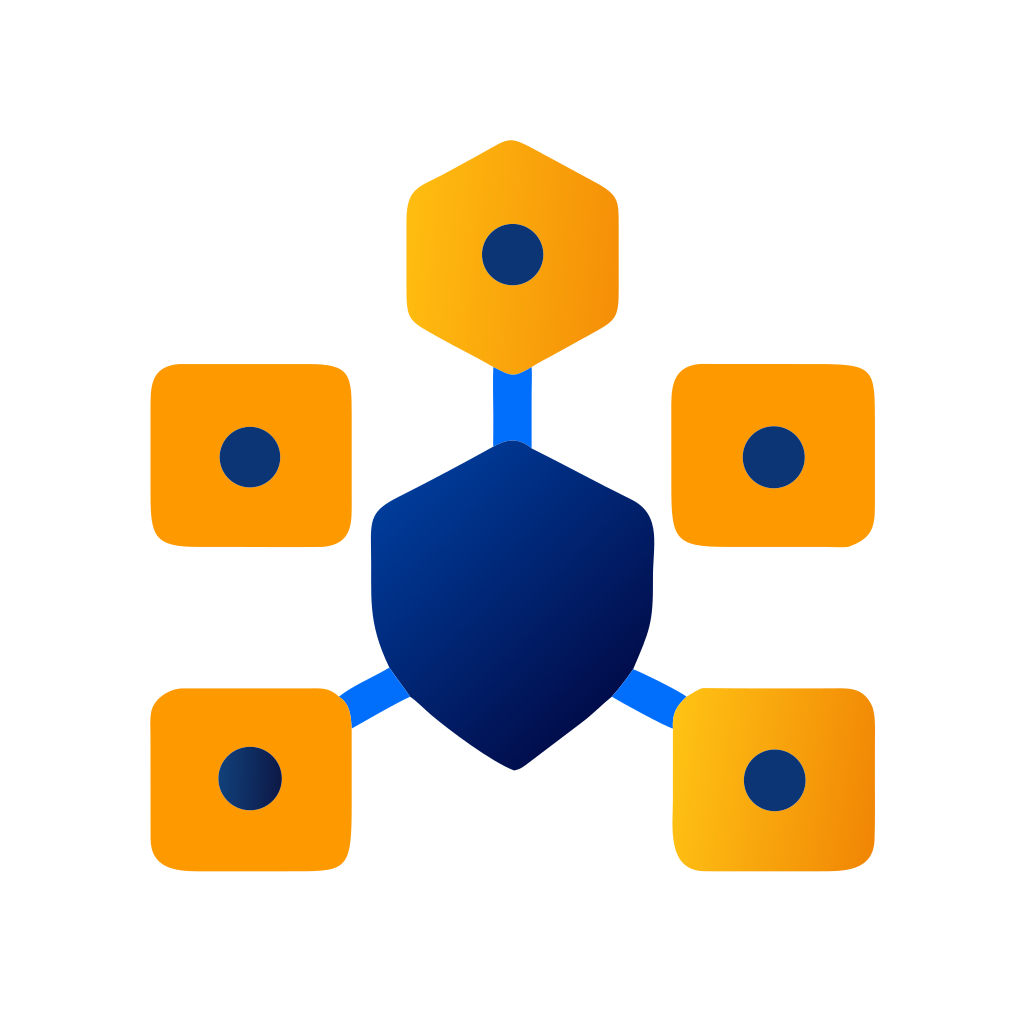
CEP orchestrates a layered defense for cloud infrastructure. It utilizes IaC Security, automated configuration management and granular access controls to establish a secure foundation. CEP further bolsters security with data encryption, network segmentation, secrets management and continuous vulnerability scanning. By integrating CSPM and Kubernetes Security, CEP provides a comprehensive approach to safeguarding cloud environments.
CSPM functions as an automated security analyst for your cloud environment. It leverages security best practices and compliance frameworks to continuously assess your cloud configuration, identify security weaknesses, and prioritize potential risks, allowing you to address them before they become exploits.
PA Prisma CloudProvides a comprehensive CSPM platform, encompassing workload and container security, cloud resource configuration monitoring, and compliance checks. It offers a unified view of your entire cloud environment.
 Wiz
WizFocuses on cloud infrastructure security; identifies misconfigurations and vulnerabilities across cloud resources (storage, compute, network) and helps ensure adherence to security best practices.
Aqua SecuritySpecializes in container security, but also offers CSPM features like cloud workload protection and configuration management. It caters to organizations heavily invested in containerized applications.
 Tenable Cloud
Scans cloud environments for vulnerabilities in configurations, assets, and identities. It integrates well with other Tenable products for a more extensive security posture view.
Cloud CustodianOpen
SourceComprehensive platform with built-in policy engine. It allows you to define custom security policies and continuously monitor your cloud environment for compliance. It integrates with various cloud providers and offers remediation capabilities.
 ProwlerOpen
Source
ProwlerOpen
SourceSecurity tool that performs Cloud and Kubernetes security best practices assessments, audits, incident response, continuous monitoring, hardening and forensics readiness, along with remediations. It excels at quick assessments and offers reports in various formats.
Acts as a secure vault for critical credentials like API keys, passwords, and certificates. It centralizes storage, enforces access controls, and automates lifecycle management (rotation, expiration), ensuring only authorized applications and users can access sensitive data, minimizing the risk of exposure or misuse.
All solutions in this category offer secure storage, encryption, key management, plus access controls for secrets like API keys, passwords, and certificates. They integrate with a variety of applications and tools to manage seamless access to secrets.
 Akeyless
Emphasizes ease of use and rapid deployment. It offers a cloud-native SaaS model and pre-built integrations with popular DevOps tools, cloud providers, and security platforms. Akeyless platform also provides Secure Remote Access, KMS, and other solutions.
 HashiCorp Vault
Known for its strong security features and granular access control; caters to complex enterprise environments and integrates well with other HashiCorp products.
 InfisicalOpen
Source
InfisicalOpen
SourceFocuses on user-centric security and zero-knowledge architecture. It keeps user encryption keys entirely on client devices, enhancing user control over secrets.
 BitwardenOpen
Source
BitwardenOpen
SourcePassword manager that can be used to store personal and business secrets securely. Available as a SaaS subscription service with individual and enterprise plans with a variety of features.
Focuses on securing the entire Kubernetes cluster, from the control plane to the worker nodes: hardening the control plane with access controls and encryption, enforcing network policies between pods, and maintaining the security of the container runtime environment. By securing each layer, you create a robust defense against attacks targeting your Kubernetes deployments.
UpwindConcentrates on runtime threat detection within Kubernetes. It continuously monitors workloads for malicious activity, offering real-time protection against attacks specifically targeting Kubernetes deployments.
 KubeArmorOpen
Source
KubeArmorOpen
SourceActs as a runtime security policy enforcement engine for Kubernetes clusters. It enforces predefined security policies at the pod level, preventing unauthorized actions and potential exploits within the cluster.
NeuVectorOpen
SourceProvides a comprehensive container security platform that integrates with Kubernetes. It scans container images for vulnerabilities, detects threats at runtime within Kubernetes environments, and offers compliance checks throughout the container lifecycle.
 CalicoOpen
Source
CalicoOpen
Source CiliumOpen
Source
CiliumOpen
SourceTools focused on network security for Kubernetes clusters. Calico offers a policy-based approach to control network traffic, while Cilium utilizes eBPF technology for more granular in-kernel enforcement of network security policies within Kubernetes.
IaC Security doesn't focus on securing the infrastructure itself, but rather the code that defines it (Infrastructure as Code). It employs static analysis tools to identify misconfigurations and potential security vulnerabilities within your IaC scripts. By catching these issues early, you can ensure your infrastructure is provisioned securely and minimizes the risk of creating exploitable weaknesses.
 Armo
ArmoScans infrastructure code templates (Terraform, CloudFormation) for vulnerabilities, misconfigurations, and security best practice violations. It offers a wide range of predefined policies and can automatically suggest fixes for identified vulnerabilities.
PA Prisma CloudBroad CSPM platform that includes IaC security; scans infrastructure code for vulnerabilities and misconfigurations, aligning with overall cloud security posture.
AccuKnoxFocuses on runtime security within CI/CD pipelines, including IaC. It can block deployments built from vulnerable IaC and offers additional runtime protection for IaC-provisioned infrastructure.
Tenable CloudScans cloud environments for vulnerabilities in configurations, assets, and identities. It integrates well with other Tenable products for a more extensive security posture view.
WizBeyond IaC security, offer broader CSPM functionalities; scan IaC for misconfigurations and also assess overall security posture of your cloud environment.
 CheckovOpen
Source
CheckovOpen
SourcePolicy-as-code approach allows users to define custom security policies alongside their IaC templates, enabling highly granular control over security checks.
Is a continuous process of identifying, classifying, prioritizing, and remediating security weaknesses in your systems and applications. It involves a combination of automated vulnerability scanning tools, threat intelligence feeds, and manual security assessments.
PA Prisma CloudBroad CSPM platform that includes vulnerability management. It scans cloud resources, containers, and workloads for vulnerabilities, providing a centralized view.
 Tenable Nessus
Commercial vulnerability scanner that identifies vulnerabilities in operating systems, applications, and devices. It offers extensive coverage and advanced features. Nessus is the de-facto standard in Vulnerability Scanning.
 NucleiOpen
Source
NucleiOpen
SourceVulnerability scanner that excels at identifying vulnerabilities in web applications through a unique templating system.
 reNgineOpen
Source
reNgineOpen
SourceVulnerability scanner focused on network infrastructure devices.
 OpenVASOpen
Source
OpenVASOpen
SourceVulnerability scanner addresses a broader range of targets like operating systems and applications, similar to commercial scanners.
Data security requires a multifaceted approach to safeguarding sensitive information throughout the data lifecycle. DLP acts as a first line of defense, employing data discovery, classification, and access control mechanisms to prevent unauthorized exfiltration of sensitive data. DSPM complements DLP with a broader perspective. It utilizes automated tools to continuously monitor data storage, access patterns, and user activity across the organization's cloud infrastructure, identifying and mitigating potential security risks, to ensure comprehensive data protection.
Monitors and controls data movement across your network, endpoints, and cloud environments. By setting DLP policies, you can identify and prevent unauthorized data exfiltration through activities like emailing customer records, copying trade secrets to USB drives, or uploading sensitive data to unauthorized cloud storage.
PA Prisma CloudOffers DLP as part of its broad CSPM platform. It focuses on cloud data security, preventing sensitive information leakage from cloud storage and applications.
 Cyera
Cyera Varonis
Specializing in DLP. They monitor and control data movement across your entire IT infrastructure, including cloud, endpoints, and on-premises systems. They offer features like data encryption, access controls, and anomaly detection to prevent unauthorized data exfiltration.
 CrowdStrike Falcon
Couples endpoint security with DLP capabilities. It focuses on preventing data breaches by monitoring endpoint activity and user behavior for suspicious data exfiltration attempts.
Takes a holistic approach, analyzing your data landscape to identify sensitive data types, assess data security risks, and ensure compliance with regulations.
PA Prisma Cloud (Dig Security)Specifically designed for DSPM; integrates seamlessly with the broader Prisma Cloud platform for a unified security posture. Its comprehensive scope encompasses cloud, endpoint, and workload security within one DSPM solution.
VaronisExcels in user behavior analytics, data access controls, and user behavior analytics. Traditionally focused on on-premise data security, although with a strong Cloud solution.
Tenable Cloud (Eureka)Mainly endpoint data security and incident response. It mostly focuses on on-premises and endpoint data security.
Integrates security measures throughout the process, from data ingestion to model deployment. This includes securing data pipelines to prevent data poisoning, implementing access controls to safeguard models and training data, and continuously monitoring for potential biases or vulnerabilities in deployed models.
 Protect AI
Comprehensive MLSecOps system that detects adversarial attacks, data leakage, and integrity breaches in machine learning models. It also monitors model usage and enforces access controls to ensure responsible AI practices; can help in analyzing models to understand their decision-making processes and identify potential biases.
 LLM Guard (part of Protect AI platform)Open
Source
LLM Guard (part of Protect AI platform)Open
SourceCan identify attempts to manipulate LLMs with malicious prompts. It prevents sensitive information from being revealed through LLM outputs and can filter out toxic or inappropriate content generated by LLMs.
 ModelScanOpen
Source
ModelScanOpen
SourceFocuses on detecting data poisoning and concept drift in machine learning models.
 GarakOpen
Source
GarakOpen
SourceEmphasizes explainability and fairness in machine learning models. It provides tools to analyze models for potential biases and helps improve their explainability.
Security compliance necessitates aligning an organization's security posture with established industry standards and regulations. This often involves implementing a comprehensive security framework, such as ISO 27001, which provides a structured approach to managing information security risks. Frameworks like SOC 2 or PCI DSS offer more specific requirements tailored to protecting sensitive data (SOC 2) or payment card information (PCI DSS).
Leveraging automation and orchestration tools, automated security compliance establishes a continuous security posture verification framework. This framework employs real-time security assessments and configuration management tools to identify and remediate deviations from predefined security baselines and industry regulations (e.g., PCI DSS, ISO 27001, SOC 2).
 Anecdotes.ai
Offers broad compliance management across various frameworks, with a focus on streamlining evidence collection and demonstrating continuous compliance. It also offers an optional Risk Management Module for a more holistic view of security posture. Automatic evidence collection, compliance status reporting, alerting and continuous monitoring are included.
 Drata
DrataFocuses on automating compliance for security and privacy frameworks like SOC 2, HIPAA, and GDPR. It offers “Adaptive Automation” for creating custom security control tests. Automatic evidence collection, compliance status reporting, alerting and continuous monitoring are included.
OpenSCAPOpen SourceOffers a technical approach to compliance automation. To achieve compliance according to frameworks including PCI DSS, FEDRAMP, USGCB, and more.


 Continue conversation
AI assistant
